KM-banner1.jpg
KM-banner9.jpg
KM-banner10.jpg
KM-banner11.jpg
KM-banner12.jpg
KM-banner13.jpg
KM-banner14.jpg
KM-banner15.jpg
KM-banner16.jpg
KM-banner25.jpg
KM-banner24.jpg
KM-banner23.jpg
KM-banner22.jpg
KM-banner21.jpg
KM-banner20.jpg
KM-banner2.jpg
KM-banner19.jpg
KM-banner18.jpg
KM-banner17.jpg
KM-banner26.jpg
KM-banner27.jpg
KM-banner28.jpg
KM-banner29.jpg
KM-banner3.jpg
KM-banner30.jpg
KM-banner31.jpg
KM-banner4.jpg
KM-banner5.jpg
KM-banner6.jpg
KM-banner8.jpg
KM-banner7.jpg
Shadow

The Sudden Passing of our Friend Karma Lhudrup Nerutsang

It was a sad event that Lhundrup Nerutsang suddenly passed away this morning. In comparison to most people, he was very community-minded, an paragon of a faithful and devoted student who strove to serve his lamas and Buddhism. For me, he was a friend who would do whatever I wished.

Now from the shores of the human world close to you, I raise my voice in a loud and clear prayer and aspiration, hoping that you have a guide down the bright path of happiness to lasting comfort. O! Life is so easy to lose, so friends, during this brief human life treasure your health of body and mind and your friends and relatives so as not to put off virtuous acts till tomorrow or the next day but to do them from today.

       Karmapa Ogyen Trinley Dorje
Canada, June 5, 2017

Third Cohort of Nuns Trains to be Health Workers


Monlam Pavilion

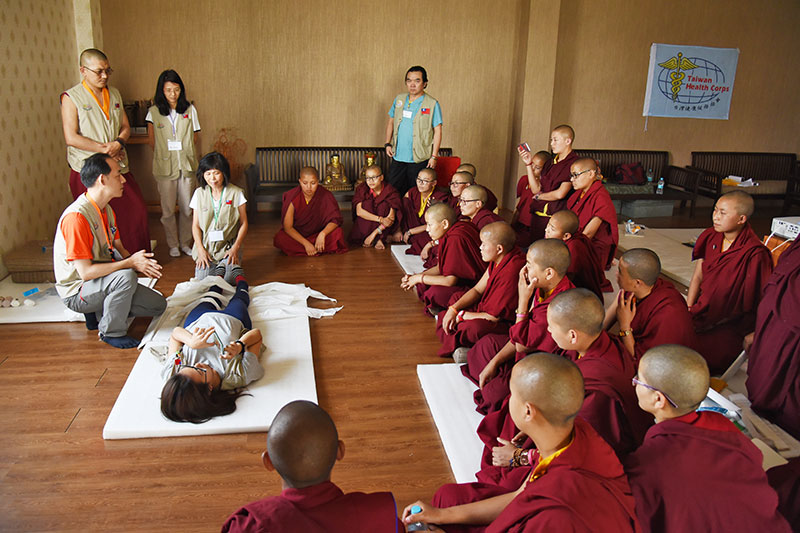
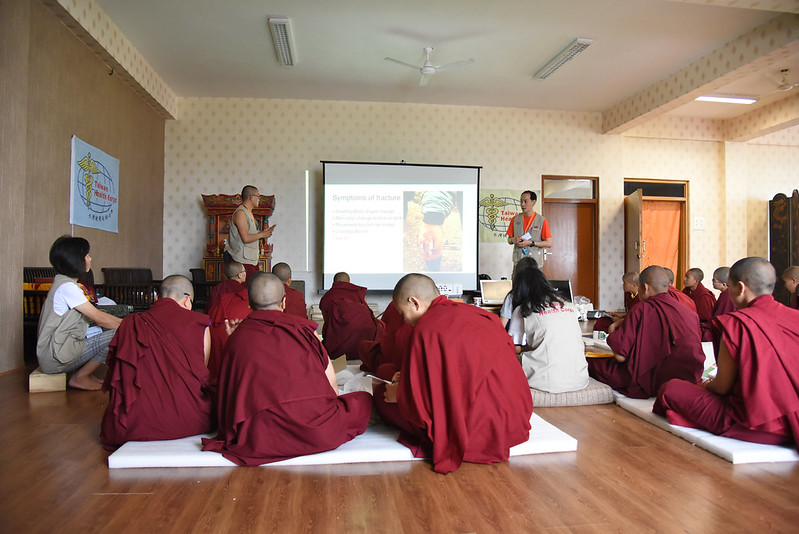
For the third year in succession, the Taiwan Health Corps has been working with Kagyu nuns during the Arya Kshema Winter Dharma Gathering.

Twenty-one nuns from eight nunneries—Ralang, Tilokpur and Palpung Yeshe Rabgye Ling in India, Karma Leksheyling, Tara Abbey, Osel Karma Thekchöling and  Samten Ling in Nepal,  and Drubde Palmo Chökyi Dingkhang in Bhutan– have successfully completed a nine-day  training in basic health care.

Dr Jeffrey Chen, CEO of the Taiwanese based NGO Taiwan Health Corps, first responded to a request from the Gyalwang Karmapa to develop initiatives to improve the health and healthcare of nuns more than three years ago. This year he has returned for a third time with a team of six health professionals to provide basic training for a new batch of nuns. The team comprises Professor Kuo Su Chen, a specialist in Women’s Health, Dr Chin Min Yi, a doctor of traditional Chinese medicine, Dr Wei Cheng Chou, urologist and surgeon, Hsin-Yu Lee, an EMT instructor, and Nurse Practitioner Lee Shun Yun.

Jamyang Dorje, who runs the clinic at Namo Buddha [Khenchen Thrangu Rinpoche’s monastery in Nepal] has joined the workshop this year as translator for the programme. Information, instructions, questions and answers have to flow continuously between English, Tibetan and Nepali.

The overall mission of the THC is to facilitate essential healthcare in remote areas and small communities by training up health workers who can provide first-line medical assistance.  Though the Bodhgaya programme is only for nuns, THC operates a similar programme in Nepal for monks. Topics covered during the nine days are: women’s health; basic anatomy and physiology; the Heimlich manoeuvre; CPR; preliminary intervention for head injuries, fractures, bleeding etc (first aid); setting up a health-care station; preliminary intervention treatments for diarrhoea; the use of commonly available pharmacology; an introduction to Chinese medicine.

For the first three days of the programme, in order for the nuns to be able to attend the Gyalwang Karmapa’s teachings in Tergar Shrine Hall, training started early and finished late. The first session ran from 7.30am – 9.30am, and then, after lunch, there were two sessions, from 1.30pm – 6.30pm and from 7.30pm – 8.30pm. On the other six days classes ran from 8.30 am – 12.30pm and 1.30pm – 5.30pm.

THC emphasises the  practical application of what is being learned, so that, by the end of the course, the nuns not only know the theory but can actually do it and, as, Dr Chen recounted,  nuns and monks from earlier THC training programmes provided invaluable help in monasteries and villages after the devastating earthquakes in Nepal. Indeed, nuns who had trained during the January 2015 health worker programme were recruited to help Dr Chen at the hospital in Kathmandu where his team were based after the earthquake. “It was very shocking for them at first,” he explained, “to see such traumatic injuries in real life, open wounds, bones sticking through the skin. But they did really well and it gave them first-hand experience in emergency trauma care.”

The Gyalwang Karmapa visited the course twice. The first time he watched the class and showed great interest in the removable body parts of the anatomical dummy. He took out the lungs and the liver and then, holding up the heart, to everybody’s delight, he joked, “This is my heart!” The second time, the Karmapa came to the closing ceremony, thanked the doctors and nurses, congratulated the students, and presented course completion certificates to the participants.

Though the THC team are the instructors and the nuns are the students, Dr Chen feels strongly that there has been a two-way exchange of learning.

"Actually we are meant to be the teachers, “he reflected,” but we are learning a lot from them.  It's difficult to explain, but working with these nuns [and monks] has brought about changes in my mind. For example, previously, small things would irritate me, make me feel uncomfortable or angry. Now, I find those little things are no longer important. And my respect for them and their culture has grown tremendously.”

Likewise, he has learned a lot from his interactions with the 17th Karmapa.

“When I am going to see him," Dr Chen continued, “I usually have a lot of questions and suggestions or I want to talk about problems...but then when I meet him, everything falls into place, and all the problems and questions seem insignificant. I am left with nothing more to say.”

It has been an intensive nine days, but already the planning has begun for next year. In 2018 THC hopes to take the programme to a new level and is planning to run an advanced course in first aid skills for between 30 - 40 nuns at Tergar during the Arya Kshema.  The nuns will learn how to suture a wound and how to remove the sutures, and how to use a defibrillator alongside CPR. They will also learn basic acupuncture and moxibustion techniques.  A parallel course will be held for monks in Nepal.  THC will then donate a defibrillator to all the monasteries and nunneries where someone is trained to use one.

In addition, the team has prepared a new health manual which can be used on the courses and distributed across the nunneries. Dr Dawa, a member of the Kagyu Monlam medical team who has previously worked on the training courses with Dr Chen, is currently translating it into Tibetan.

As for the nuns themselves, it has been a steep but exciting learning curve; they are all confident that now they are equipped to better help not just their nunneries but the community in general.  


2017.03.14 Third Cohort of Nuns Trains to be Health Workers

A Joyous Celebration to Conclude the 34th Kagyu Monlam


The Monlam Pavilion, Bodh Gaya, Bihar, India

The Pavilion stage underwent its final transformation of the Monlam into a space of simplicity with just the Buddha, a tall flower arrangement on either side of him, and in front, a seat and table for the Karmapa. The rest of the stage was cleared to give maximum space for this evening’s performers at this Marme Monlam, the Lamp Prayer. In front row of the audience were seated the Karmapa, Gyaltsap Rinpoche, Mingyur Rinpoche, Bokar Rinpoche’s Yangsi, and numerous other tulkus and khenpos. Also attending were two lamas from Hong Kong, the Ven. Master Kung Siu Kun and the Ven. Master Sik Yun Tsun.

A formal invitation had been sent to Indian dignitaries and many were present. Among these honored guests seated near the Karmapa were Amitabh Mathur, advisor to the Ministry of Home Affairs on Tibetan affairs; the District Magistrate of Gaya, Kumar Ravi (Indian Administrative Service, IAS); Senior Superintendent of Police of Gaya, Garima Malik (Indian Police Service, IPS); Airport Director, Dilip Kumar; Bodhgaya Temple Management Secretary, Nangsal Dorjee (retired IAS); Indian Government Liaison Officer, Lalit Kumar; and Central Tibetan Administration, Department of Religion and Culture, Karma Thinley. Also adding their presence to this concluding ceremony were the leaders of all the main monasteries in Bodh Gaya as well as heads of the major NGOs in the area.

In the beginning, the Karmapa was invited to speak, and after extending a warm welcome to everyone, he spoke about the purpose of the Kagyu Monlam.

By training in compassion for three countless eons, the Buddha brought compassion to its perfection. Due to this, when he engaged in taming and subduing living beings, he was not limited to a single method but knew many different ways to benefit beings. This could be seen as a special aspect of the Buddha. Though we cannot do it exactly as the Buddha did, we are trying to use a variety of ways to plant the seeds of liberation, to create Dharmic imprints within the being of all those who have come.

The Karmapa remarked:

We were joined by the Sanghas of many different countries. This is to send the clear message of our wish to have strong and harmonious connections with all religious traditions, especially other Buddhist Sanghas. We have given considerable thought to this, and it is good that everyone here know of this intention as well.

As examples of these relationships, the Karmapa mentioned the memorial service for the King of Thailand; the visit of the Bangladeshi monks who brought Atisha’s ashes; and the Sangharama ceremony that incorporated Chinese monks and prayers. Turning to a favorite topic of the environment, the Karmapa explained:

The theme for this evening is the environment, so the performances tonight will depict the situation of the environment and how important it is. Especially in our 21st century, protecting the environment is the biggest challenge we face.

Finally the Karmapa described how the Monlam had been arranged and the feeling he hoped it would evoke:

The main point I’d like to make is that this evening’s program resembles the preparations parents make for the time when their children return home after a long absence. The parents cook the best food possible and do all they can to make the occasion enjoyable. It is the same for us here at the 34th Kagyu Monlam. We have tried to make everything as meaningful and beneficial as possible. We thought, “Oh, an empowerment would be good,” so we added that to the schedule. “Dharma teachings would bring blessings,” so we included them.


Making the schedule like this is easy, but implementing it is much harder. Sometimes I even get angry with myself for filling it so full. But I think it should resemble the feeling parents have in anticipating the return of their children. I hope you all feel the same way, that you enjoyed the programs we have set up, and that they will benefit you in the short term and ultimately.

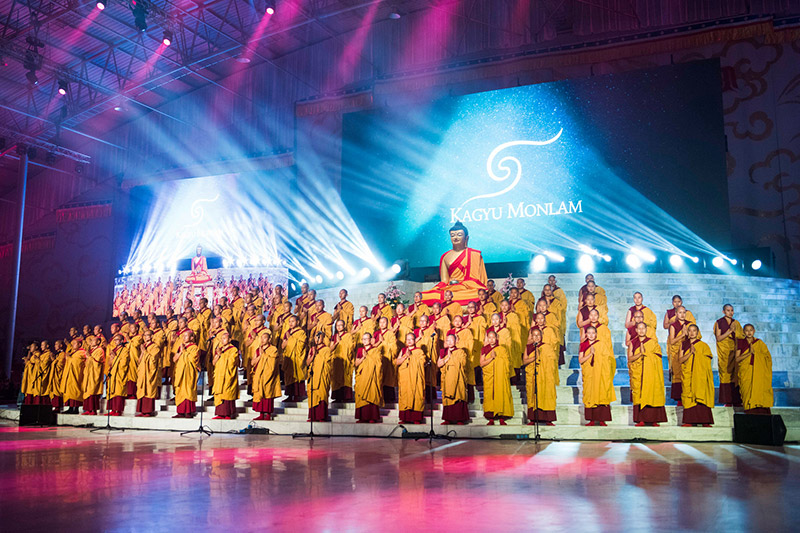
During the Marme Monlam, it has become traditional at the Monlam to begin the evening’s program with the practice of Avalokiteshvara known as Benefitting Beings Throughout Space, the greatest method for receiving his blessing and developing compassion. As the lights came up, the burgundy and yellow-robed Sangha filed in to array themselves in perfect rows, fanning out along the semi-circle of the marble steps below the Buddha. The chanting began with the nuns from Drupde Palmo Chökyi Dingkhang Nunnery of Khenpo Tsultrim Gyatso in Bhutan, and then the monks from the Vajra Vidya Institute of Thrangu Monastery joined in. At one point their traditional chanting shifted into a lovely western harmony that was a new touch.

Afterward Mr. Zheng Yong Chen on the suano (resembling a simple, straight trumpet) and Ms. He Yi Jie on the mouth organ played a traditional Taiwanese melody entitled, The Hundred Birds and the Phoenix, to remind everyone of the enjoyable qualities of celebrating the New Year, and the need to maintain and spread such joy.

Protecting the environment includes being stewards to the snowy mountains, the crown jewels of the earth, which according to Tibetan tradition host gods, nagas, local deities, spirits, heroes, and dakinis. Li Kong Yuan from Taiwan, composed the song, Flowing Water, for the zither, a stringed musical instrument, placed and played horizontally. He plucked and strummed as if recreating the sound of water dripping slowly and descending down the snowy mountain, reminding the audience of the importance of mountains for nourishing our water supplies and sustaining our climate.

In the spirit of demonstrating both a commitment to the interconnected relationships among the various lineages across Buddhist communities world-wide and an on-going concern for the environment, the well-known Bhutanese playback singers, Mr. Karma Phunstok and Ms. Chimi Wangmo, composed a new duet especially for the Marme Monlam entitled, A Song Dedicated to the Karmapa.  Both performers expressed their gratitude for the opportunity to create and perform their offering to His Holiness.

Next, two Mongolian artists performed a song that touched on the relationship between humans and animals. As Mrs. Khongor Zul sang in a piercing, high voice, loved by Tibetans, too, Mr. Munkhzaya played the Mongolian horse-head fiddle with the resonant sound of a viola, rendered complex by feedback cycles playing against their own overtones. The story behind the name of his instrument is that once there was a poor boy who fell in love with a girl whose father did not like him. The boy was riding his horse to come and see the girl, so the father killed the horse. From it, a  musical instrument was fashioned: the horse’s head became the sounding box, the hair of its tail became the strings, and so forth.

Wherever we look in samsara and nirvana, we see how significant the sun and water are but we still need to remind ourselves to respect and cherish them. To celebrate these basic elements of our lives, the well-known composer/performer Nitin Sawhney was joined by special guests Aref Durvesh on tabla, Ashwin Srivasen on Bansuri flute, and Kara Marni, on vocals as they performed two songs, Sunset and the famous River Pulse. When he introduced River Pulse, Nitin Sawhney commented, “I wrote this piece when I was sixteen about the Buddha’s enlightenment and never imagined that I would come to Bodh Gaya to play it. Thank you.”

In an earlier interview in Bodh Gaya Nitin spoke about this music:

The second piece we’re playing tonight is a piece I wrote called River Pulse, which is the only piece I’ve ever written that has to do with anything Buddhist. When I wrote it, I had the image in my mind of the Buddha sitting under the Bodhi Tree and the idea that the pulse of the river gave him enlightenment. Of all the songs proposed to him, the Karmapa asked me to play this piece, and he had no way of knowing that I wrote it purely about the Buddha’s enlightenment. The fact that he chose it is the main thing that made me want to come here, as I thought, “Well then, it’s supposed to happen.”


Q: Have you ever played for a spiritual teacher before?


NS: No, but one great thing that happened to me was interviewing Nelson Mandela. I think he was an amazing human being. I can’t, however, think of any spiritual teacher off the top of my head.


MM: This is the first time then.


NS: Yes, I think it probably is. It feels very natural to be here and very good. I like how relaxed the Karmapa is. How he walks around with humility and with the sense of being with people. He’s not arrogant or anything like that, which is a great thing, because he could be but he’s not, which is great to see. [Read the complete Nitin Sawhney interview here.]

The surging waves of River Pulse flowed out through the crowd and into the space beyond, where the distant Mahabodhi Stupa illuminated the night sky.

The Mongolians returned augmented by Mr. Liter from the area of the Blue Lake in a Tibetan and Mongolian cultural area, and by Mr. Yavgaan, father to Mr. Munkhzaya, and famous throughout his homeland for his throat singing. His long blue robe reflected the deep azure of the vast Mongolian skies. At 71 years old, he has been singing for 64 and performing for 50. Music is in his family’s tradition so he learned the special techniques of throat singing from his brother and has passed the love of music to his son, performing with him tonight.

In an earlier interview, Mr. Yavgaan spoke about throat singing and how he makes this especially resonant sound. He indicated his belly, heart, throat, and forehead saying that they all have to resonate together as a whole, so there’s a flow like a river’s current; otherwise, the sound does not come. For the listener, the singing cycles up high and down low, and often it is difficult to tell exactly where the sound is coming from.

The group gave a rousing performance of a song about the Mongolian landscape, its grasslands, a tall mountain, the nomad life of changing residences in the summer and winter, and the great vistas in areas so isolated, one can go for 100 kilometers and not see anyone. At the end of their piece, the artists raised up their instruments with both hands, making an offering of their music.

Karma Sönam Palden from Taiwan performed a song that juxtaposed the effects of earthquakes caused by buddhas and bodhisattvas, which are harmless and generate mental and physical equanimity, against those created by the shifting and accumulated friction of the earth’s plates that are the source of immense suffering and pain for communities world-wide. The lyrics were composed by His Holiness and the music by Karma Sonam Palden.

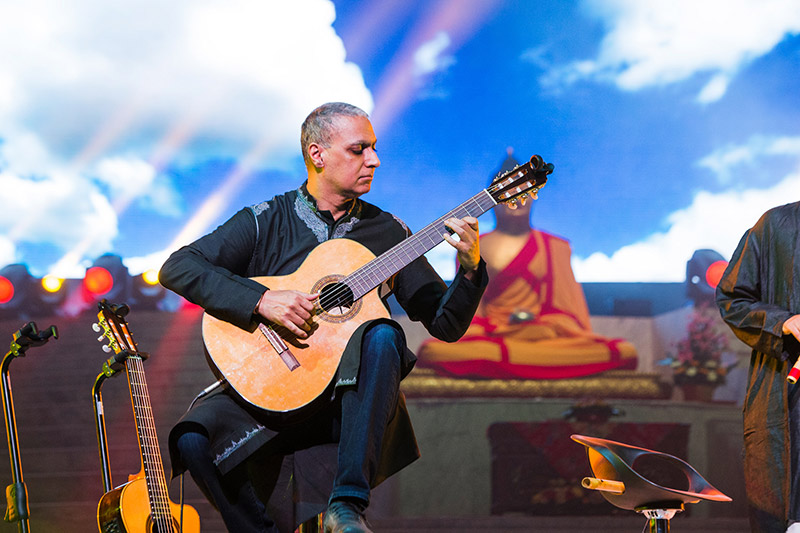
Before His Holiness concluded the 34th Kagyu Monlam, the penultimate act included two well-renowned guitarists and twenty performers. These musicians from China and artists from the Tibetan Institute of Performing Arts (TIPA) performed two songs about recalling and supplicating the guru with devotion and beseeching the great master for blessings. His Eminence Pawo Rinpoche, one of the heart sons of His Holiness, composed the Classical Mandarin lyrics for the first song, which the musicians set to traditional Chinese music. Following a solo, performers joined a young professional Chinese singer in accompaniment to this devotional song, whose refrain was Karmapa Khyenno.

The final song was a rock performance that began with dueling guitars that transitioned into Tibetan lyrics taken from mantras and the refrain Karmapa Khyenno.  A young Tibetan monk and Chinese child performer stole the final act with their eager smiles and earnest off-beat clapping. For the finale, all the performers descended the stairs and lined up across the front of the stage swaying while rallying the crowd into rhythmic clapping, bringing the performances to an up-beat and lively closure before a final supplicating bow to His Holiness.

As usual, the evening closed with the offering of lights. The master of ceremonies explained that the forms of light we usually offer actually represent a very profound lamp. As a lamp is essentially luminous, so the essence of our minds is luminous wisdom.  Within the nature of this luminous wisdom, the unceasing display of wisdom is called the vast realm of the dharma expanse.

The ultimate teaching is to rest freely in the luminous essence of the mind itself without altering anything. When devotion—the quality that is sufficient on its own—reaches the critical point, luminous wisdom—the self-arisen, essential nature of mind—is revealed free of obscuration. This is merely designated as the ultimate result, the dharmakaya. In actuality, the ground to be realized is the luminous essence of mind; the path to practice is the luminous nature of mind; and the result is realizing the luminous nature of mind. The essence of luminous, self-arisen wisdom that is the nature of our minds is the greatest lama of the definitive meaning.

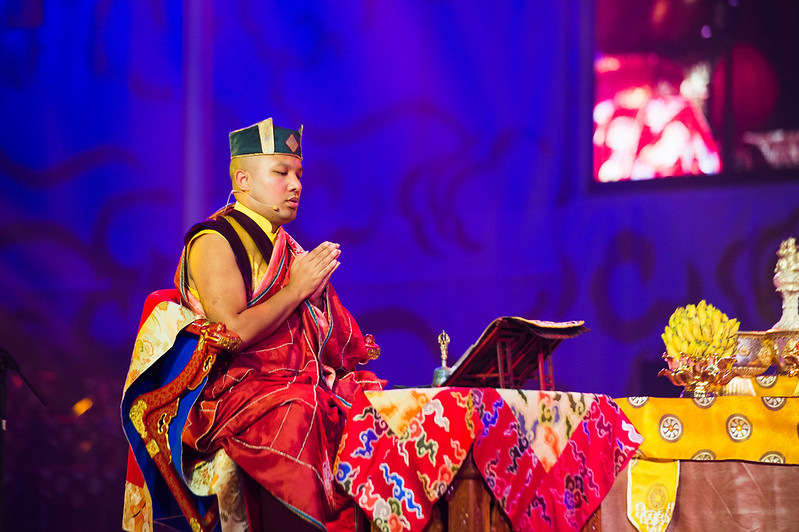
With this profound understanding, the audience was asked to sing the Lamp Prayer, composed by Atisha, whose relics were recently offered to the Karmapa. First he read the text in sections, which disciples repeated in Tibetan followed by English and Chinese. Then the prayer set to music rose from the depth of those present. The Karmapa held his lotus lamp at his heart as two nuns walked up the stairs to his seat and, lighting their lamps from his, passed the light to the sangha on either side of the Karmapa. Through the expanse of the audience, one by one the lamps were lit, becoming constellations of moving flames to illuminate the night.  

The last prayer supplicated:

May the essence of the teachings, the teachings of the Karmapa,
The activity of the victors, victorious over the four maras,
In uninterrupted fullness fill all directions to their ends.
May this always flourish and may this flourishing be auspicious!
Sarva mangalaṃ.


20170302PM_Marme Monlam

Nitin Sawhney Plays for the Karmapa: An Interview


Monlam Pavilion, Bodh Gaya, Bihar, India

The famous musician and composer Nitin Sawhney was invited by the Gyalwang Karmapa to perform at this year’s Marme Monlam, the spectacular end to the 34th Kagyu Monlam. In a break between rehearsals, Nitin responded to questions about his spiritual path and his music, how he came to be at the Marme Monlam, and his thoughts about the Karmapa.

Kagyu Monlam Reporter: I’d like to ask you first about your childhood. There’s a spiritual current in your work and I wonder if you can trace that back to your family and its influence.

Nitin Sawhney: My mum comes from a very strong, ancient Hindu background and had an interest in ancient Hindu philosophy. She’s a Brahmin and used to recite prayers with us every Tuesday. She taught me a lot about the Vedas, even mathematics and also yoga. She would talk to us about ideas from the Vedas, the Upanishads, and the Bhagavad Gita. I’m always interested in that heritage, which was quite strong in my family.

KMR: Does it influence what you’re writing now?

NS: Yes, very much. What’s interesting is that the second piece we’re playing tonight is a piece I wrote called River Pulse, which is the only piece I’ve ever written that has to do with anything Buddhist. When I wrote it, I had the image in my mind of the Buddha sitting under the Bodhi Tree and the idea that the pulse of the river gave him enlightenment. Of all the songs proposed to him, the Karmapa asked me to play this piece, and he had no way of knowing that I wrote it purely about the Buddha’s enlightenment. The fact that he chose it is the main thing that made me want to come here, as I thought, “Well then, it’s supposed to happen.”

Actually, there are a lot of stories around this. Just before I came Bodh Gaya, I was staying at a yoga retreat that gave me time to prepare myself mentally and spiritually for being here. There was ayurvedic and yogic practice as well as different exposures to Indian classical music. I even read a book about Buddha while I was there.

In terms of my childhood, I think my mum and dad gave me their perspective on what Hinduism meant to them. In some ways I think religion has been difficult for me because sometimes it can get in the way of spirituality, so the two can be in conflict. But the way my mum and dad taught me about Hinduism, there was no conflict. I felt very much at peace with the idea of spirituality and the essence of it.

KMR: Is that because their approach was more experiential?

NS: Yeah, I think so. And also music has been a very, very good way for me to find a lot of truth. I think music is the voice of the universe. In my perspective, OM was the first word that was uttered. That’s very powerful, as I think it manifests itself when we’re playing “River Pulse” or even “Sunset.” There’s the concept of playing in a key, which is actually the implied OM that is around us all the time. We’re playing from that beginning always. It resembles an idea from Pandit Ravi Shankar who said, “You’re a vessel to be filled with the feeling and the sound of the universe.” It comes through you and you’re just a medium for it to manifest. I really liked this idea.

I’m also interested in the idea of being in tune with yourself. As a musician, you have to tune your guitar, and when you play with other people, you have to tune to them. I think it’s the same when you come to a new country or place. You might be in tune with yourself, but you have to tune again to the place you’re in and to the people around you. I don’t really go with the morality kind of concept of right and wrong or good and evil—this is too much of a dichotomy. I’m much more into the idea that we flow with  discord or not. If we are discordant with what is around us, then it feels wrong, it doesn’t work. But if you are in tune with yourself and what’s around you, then everything flows very smoothly.

KMR: In Buddhism, there are the concepts of the ultimate and the relative, which are inseparable. You can move from the relative into the ultimate, and through the dynamic compassion, the ultimate becomes embodied as the relative.

NS: You’re right. It’s the dynamic of compassion. And to be compassionate, you have to be in tune with yourself first. Compassion cannot come from someone who is not at ease with themself, who is insecure, worried, or anxious.

It’s like music. If you’re playing music and the notes are not in tune, you just automatically stop playing because it doesn’t feel like it’s working. It’s the same thing with the way we are – I guess.

KMR: Sound is also interesting for its ontological status. It’s not a solid thing like this table and yet it’s not nothing either. It occupies a space somewhere in between.

NS: It’s interesting that you should say that. There’s a mathematician named G. H. Hardy who once said that the only true reality was mathematics, because it’s something that never changes. Like you said, the table appears to be solid, but actually 100,000th of diameter of each atom is the nucleus and that’s where most of the matter is, so actually everything we see around us is mainly emptiness.

Music is like this too. Einstein said that relativity came to him through musical intuition, so it’s actually his realization of what the universe was. This understanding of the universe came to him through musical feeling, so I think music is a very powerful voice of the universe.

KMR: And it’s used in all spiritual traditions. They all chant and sing. There’s also something about the vibrations of our own voice or a musical instrument lightening the solid sense our body, so it’s easier to tune into what’s called the body of light.

NS: I agree. I think that’s very true. When you play music there’s a transformation of your normal self into more of an extension of the universe, rather than just being an isolated being. That’s why I love playing with other musicians, because you’re communing together with the voice of the universe.

KMR: Is there a sense also of flowing out to the audience?

NS: Very much. I think there’s electricity that happens between the musicians and between the musicians and the audience. There’s a feeling that spreads. If you have a good spirit between you on stage and it’s working, then it’s effortless for that to spread. You don’t have to try to make it spread; you just feel it and everyone can feel the same. It’s an infectious feeling rather than a performance feeling.

KMR: One of your albums is titled OneZero, which is very Zen, and your aesthetic is also minimalist. That’s quite different from the profusion of Hinduism.

NS: There are different interpretations. Hinduism was originally an oral tradition. The ornamentation of how temples look or the aesthetic of how Hinduism looks these days is like the catholic church. It’s like Martin Luther when he broke away from the catholic church. He said he was justified by faith alone. He turned around and in 1517 he nailed up the Ninety-Five Theses on papal indulgences at the church in Wittenberg. In a way, the beginning of Protestantism was a breaking away from all that kind of ornamentation and opulence that the catholic church demonstrated.

I feel that as well about anything that is too demonstrative of opulence. I naturally shy away from it. I’m much more interested in a pure form of expression that comes from a feeling which is effortless. You don’t need to have lots of ornamentation or attempts to beautify anything.  What is graceful is automatically beautiful. In the music you play or whatever you do in life, there should be a sense of grace to the way it works, and then there’s no effort involved.

KMR: In Buddhism, there’s the idea of approaches being elaborate or unelaborate. Emptiness is described as unelaborate, so it doesn’t have a lot of conceptual proliferation around it. It’s just very clear and simply is what is.

NS: Yeah. Absolutely. That’s the thing, and I always like to start everything from emptiness as much as I can. I like to take time before I begin a track, or anything really, to just be in the moment without rushing, because the music should come from that moment and not from panic about what happens next. That’s the danger. When music doesn’t work for me is when you can hear the panic. For me music should always come from somewhere that sounds gradual and gentle. Even if it comes with a lot of energy, the energy comes from somewhere graceful.

KMR: Do you meditate?

NS: I meditate a lot through music and I also take time to do yoga every day. During that I normally do some breathing techniques and just before I start the yoga session, I’ll have ten to fifteen minutes of silence and meditation.

KMR: Patanjali Sutra has wonderful teachings on the mind, which are similar to Buddhism.

NS: Interestingly Patanjali talked a lot about ideas that were actually impossible in modern thinking, like the idea of flying or levitating. I think that is symbolic of breaking free from or expectations of yourself or limitations you place on yourself psychologically. Everyone has insecurity about their capabilities or their context or how they relate to other people. It’s important to find your own sense of value with yourself.

Insecurity breeds fear, and fear breeds a need for power. I see this in so many places. I think this is what is going on in the world right now with certain people. It’s scary because you can see how much insecurity there is in one person and the fear that comes from it. There’s paranoia and then the need to impose power on people. This cycle creates so much hate. So I think it’s important to be at peace with yourself before you begin anything.

KMR: There’s a line in the Heart Sutra that has always fascinated me. It says that since the bodhisattvas have no afflictions—no ignorance, hatred, attachment, pride, jealousy, etc.—they have no fear. So if your mind can touch into that inner purity or emptiness, there is no fear.

NS: Buddha found enlightenment by escaping suffering and pain. He transcended the cycle of suffering and pain that we’re all in.

KMR: And that suffering comes from these negative afflictions.

NS: Yes. And I think this is one of the beautiful things about music. When you are playing music and you’re in the right space, there’s the sense that, even if it’s for a short time, you can transcend all those feelings of fear, worry and anxiety and be genuinely in tune with something much bigger, much larger. It’s those moments that are very valuable.

There’s one piece I play called Prophesy, which we are not performing today. I wrote it originally as a homage to the land that I am in. It’s about listening to the drone of the insects and the sounds around you. You gradually evolve a piece of music that speeds up in the Sufi way, like how the whirling dervishes do. They spin faster and faster and it’s the same concept with the music. There’s something about celebrating the universal power. Sometimes when you’re playing, it’s like the charging of a battery. You feel that you’re becoming more and more charged by a universal spirit that flows through you. It’s really an amazing thing.

KMR: In whirling there’s a point when the turning takes over and you’re no longer there.

NS: That’s the same with Prophesy because it’s actually a piece that speeds up in the same way. You can watch your hands and everything is working together. I’m aware of Aref on the tablas, and when we’re playing together, we’re very much as one because we’re both communing with the same thing. It’s a nice feeling.

KMR: There’s something similar in mantra practice. A seed syllable is visualized in your heart and the mantra turns around it. When you’re first working with it, you have to get used to it, think about the shapes, the colors, and the movement. Then slowly, the mantra starts speeding up and turning on its own.

NS: Exactly. It’s very powerful.

KMR: Do you think that when things go well, this gets communicated to others?

NS: I think so. As I said, when you have the right feeling between you, then that automatically, not necessarily gets communicated, but it effects the room in a good way like a benign virus. It’s more than communication, which is so linear. An infection is something that spreads, and the feeling that comes with music is like that, something that spreads around you, so it can be between people, between the air. It’s a feeling, an electricity, that’s created in a space.

KMR: You’ve also been involved in music education. Is it part of your compassionate involvement in the world?

NS: I like to do lots of work with kids, university students, and local communities. I think it’s important. With me it can be a bit selfish, too, because I learn a lot from teaching and working with younger people. You can remember what it is to learn and feel excited about something when it’s experienced for the first time. I have been showing Kara the singer how to do Vedic mathematics and mental arithmetic, for example, the 100 times table in her head. She had not done that before, and she’s been practicing and got very excited, asking me to test her. It’s nice. You think, “Oh wow. That’s what I used to feel like when I first was learning.”

It reminds you, so you don’t become complacent and take things for granted. I think it’s one of the most important things. We’re all very privileged to play music, and to play for the Karmapa in this space is a great privilege. The moment we forget that is the moment we lose ourselves.

KMR: Have you played for a spiritual teacher before?

NS: No, but one great thing that happened to me was interviewing Nelson Mandela. I think he was an amazing human being. I can’t, however, think of any spiritual teacher off the top of my head.

KMR: This is the first time then.

NS: Yes, I think it probably is. It feels very natural to be here and very good. I like how relaxed the Karmapa is. How he walks around with humility and with the sense of being with people. He’s not arrogant or anything like that, which is a great thing, because he could be but he’s not, which is great to see.

KMR: He was once asked what his mission was, and he replied, “To bring Buddhism into the 21st century.”

NS: Yes, I can see that. I get that totally. There’s a quotation from Zen and the Art of Motorcycle Maintenance, in that book it says “Buddhism is not to be found only in the petals of a flower but also in the console of the computer.” It’s a great quote. It’s not the idea of pantheism, it’s more that spirituality is within and everything else is an illusion. The idea that one thing is more spiritual than the other is crazy. Bringing Buddhism into the 21st century makes a lot of sense to me. People get buried in tradition and sometimes they can think that’s where spirituality is. But actually it’s not. It’s in our everyday life, how we speak to each other, how we respect each other, how we look at the universe, how we show compassion, how we think and feel. In that respect I think the Karmapa is saying something very wise.

KMR: One of the definitions of buddhahood or enlightenment is that there is absolutely no difference between meditating on a cushion and being out in the world. The two are equal. When they were planning a new building at the Karmapa’s seat in New York, he was asked where he wished to have his rooms. One option was on the quiet side of the structure with a beautiful, long vista of the mountains and a lake in the distance, and the other overlooked the parking lot. He chose the later so he could see people.

NS: Makes a lot of sense.

KMR: You had mentioned a history of coincidences that brought you here. Could you tell about them?

NS: When I was sixteen I wrote this piece about the Buddha under the Bodhi Tree. What happened  was, I went to see a play of Garcia Lorca, called Yerma and there was a Punjabi translation of it, which I thought was fantastic. I felt the performance to be very strong. Afterward I went back to see the director afterwards who was a woman, called Neelam Mansingh Chowdhry and I said to her, “If you ever want me to do anything for your theater company whether it’s playing music, writing it, or even sweeping floors, I don’t care what it is, I’ll do it.” I asked her, “Where do you work?”

“We work in India,” she replied.
I said, “Maybe one day I can come there.”
“You’d be very welcome.”

Three months later, I decided that I was going to try and find her, but this was back in the early 90s, and I had no way of tracking her down. So I went to India and was staying at my uncle’s house in Gurgaon near Delhi. I said to him, “ Do you know this person? Her name is Neelam Mansingh Chowdhry and she’s a great director.” He replied, “ I have no idea how to find her, but your uncle in Chandigarh might know. I’m going there at 6 o’clock tomorrow morning. Would you like to join me?” I said, “Sure.” So we were standing on the train platform and I remember looking up and seeing a monkey silhouetted against the morning sun, and then a voice next to me said “Nitin.” I turned around and it was Neelam Mansingh Chowdhry. “How are you?” she asked. I’m all right and surprised you remembered me.”

She said, “Yes, I remember. We had a nice conversation.”
“Well,” I said, “I came here to find you.”
She didn’t seem that surprised and said, “Well, we’re going to Chandigarh now. I live there. Is that where you’re going?”
I replied, “Yes, with my uncle.” “Why don’t you join us?”

So for the next two weeks, I spent time with her at her amphitheater, and then lost track of her. Fifteen years later, I was speaking with the Indian film director called Deepa Mehta, who was talking to me about writing music for Salman Rushdie’s Midnight’s Children and I said I’d love to do it. At the end of our two-hour long conversation, she said, “There’s one other thing. I really want to introduce you to somebody I know you’ll get along with.” Without her saying anything else, and even to this day, I don’t know why I said this, “Is it Neelam Mansingh Chowdhry?” “Yes, she’s my best friend. How did you know?” “I don’t know,” I replied. Then we talked for a bit.

Now I was telling this same story to a person named Veer Singh, who had invited me to stay at the yoga retreat I spoke about before. He said, “That’s amazing. She’s my aunty. That place you were talking about with the amphitheater its half owned by my grandmother.”  Veer had also had the Dalai Lama stay at the retreat and in my room there was one of his books on Buddhism I read whilst I was there. I told Veer I was coming to Bodh Gaya and he knew a lot about the Karmapa and Buddhism.

It was interesting as I had a great experience coming here. It was very purifying, even literally with detoxing. It’s strange because it feels like a very interesting path that has led me here that started a long time ago. I have had many, many coincidences in music that are crazy but this feels related to me being here in Bodh Gaya with the Karmapa today and interesting that he chose my track River Pulse to play as he wouldn’t know it was related to Buddha sitting under the Bodhi tree.


Losar Day Three: The Sangharama Ritual

Monlam Pavilion, Bodhgaya

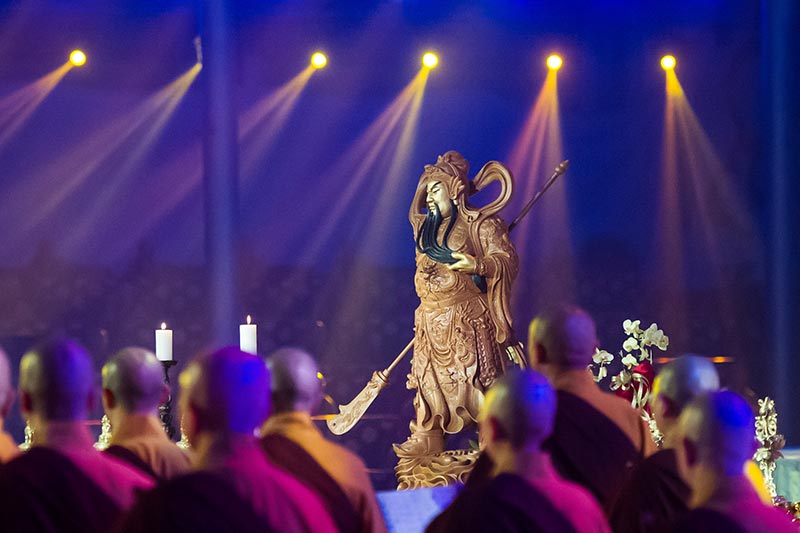
The protector Sangharama, also known by the name Guan Yu or Guan Gong, is a Chinese deity but also one of the protectors of the Karmapa’s Tsurphu Monastery in Tibet.

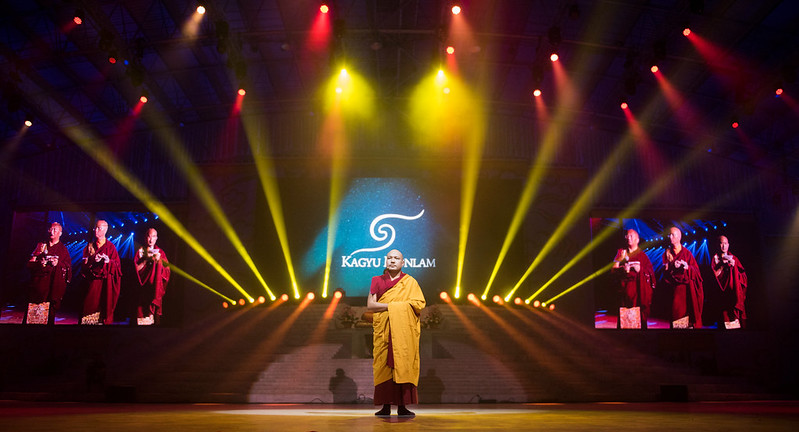
The connection between Sangharama and the Karmapa lineage began when the 5th Karmapa, Deshin Shekpa, travelled to China at the invitation of the Yongle Emperor of the Ming Dynasty. Sangharama, a local Chinese deity who lived on a mountain, was so impressed by the Karmapa, he decided to follow Deshin Shekpa back to Tsurphu Monastery, where the Karmapa offered him a new home on one of the mountains behind the monastery. It then became the tradition at Tsurphu to offer a practice to Sangharama each Losar. When the 16th Karmapa fled Tibet, the ritual was lost. The 17th Karmapa wrote a new liturgy, the one performed today, which uses both Tibetan and Chinese.
1.Prostrations to Lokeshvara (Chinese)
2. Like stars, or seeing spots, or candles...” (Chinese)
3. Refuge and bodhichitta (Chinese)
4. The four immeasurables (Chinese)
5. Self-visualization and invitation of guests (Tibetan)
6. Incense offering (Chinese)
7. Request to be seated (Tibetan)
8. Visualization of the guests (Tibetan)
9. Praises of Sangharama (Chinese)
10. Offerings (Tibetan)
11. Smoke offering (Tibetan)
12. Rejoicing (Chinese)
13. Invoking activity (Chinese)  
14. Invoking activity (Tibetan)   
15. Request to depart (Tibetan)
16. Dedications and aspirations (Chinese)
17. Auspicious prayers (Tibetan)

Visit The Sangharama Ritual Picture Story for details.


20170301PM_Sangharama Ritual