











KM-banner1.jpg
KM-banner9.jpg
KM-banner10.jpg
KM-banner11.jpg
KM-banner12.jpg
KM-banner13.jpg
KM-banner14.jpg
KM-banner15.jpg
KM-banner16.jpg
KM-banner25.jpg
KM-banner24.jpg
KM-banner23.jpg
KM-banner22.jpg
KM-banner21.jpg
KM-banner20.jpg
KM-banner2.jpg
KM-banner19.jpg
KM-banner18.jpg
KM-banner17.jpg
KM-banner26.jpg
KM-banner27.jpg
KM-banner28.jpg
KM-banner29.jpg
KM-banner3.jpg
KM-banner30.jpg
KM-banner31.jpg
KM-banner4.jpg
KM-banner5.jpg
KM-banner6.jpg
KM-banner8.jpg
KM-banner7.jpg
Shadow

Historic Red Crown Ceremony in Bodhgaya

Monlam Pavilion — Bodh Gaya, Bihar

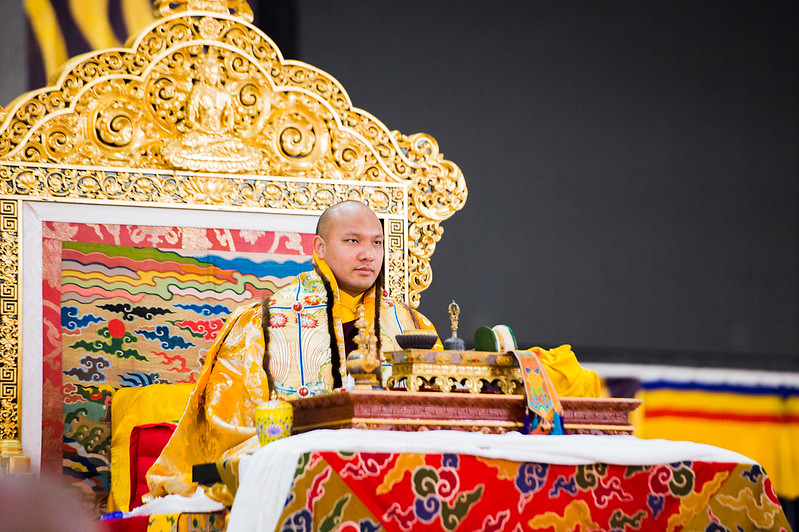
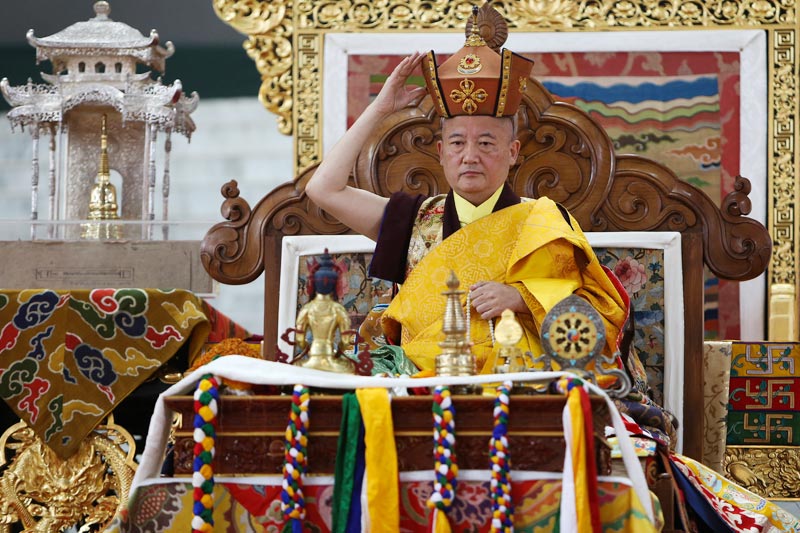
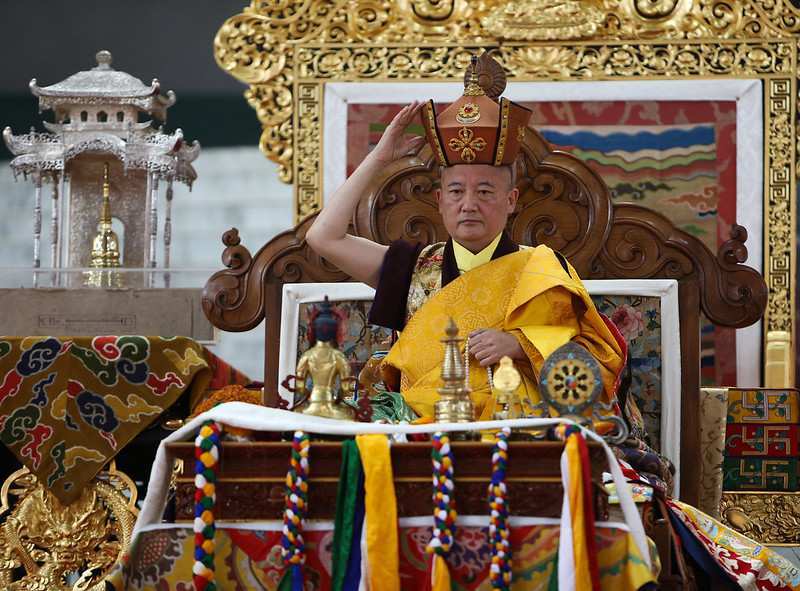
During the break, after the smoke offering Massing Clouds of Amrita had ended on Sunday morning, the stage needed to be cleared and rearranged in order for Gyaltsab Rinpoche to bestow the Red Crown ceremony and the Long Life Empowerment of the Three Roots Combined. His Holiness the 17th Karmapa personally took charge of arranging Gyaltsab Rinpoche’s throne with great respect and care; he had received the Empowerment of the Three Roots Combined from Gyaltsab Rinpoche when he bestowed the Treasury of Precious Terma, or Rinchen Terdzo empowerments some years earlier.

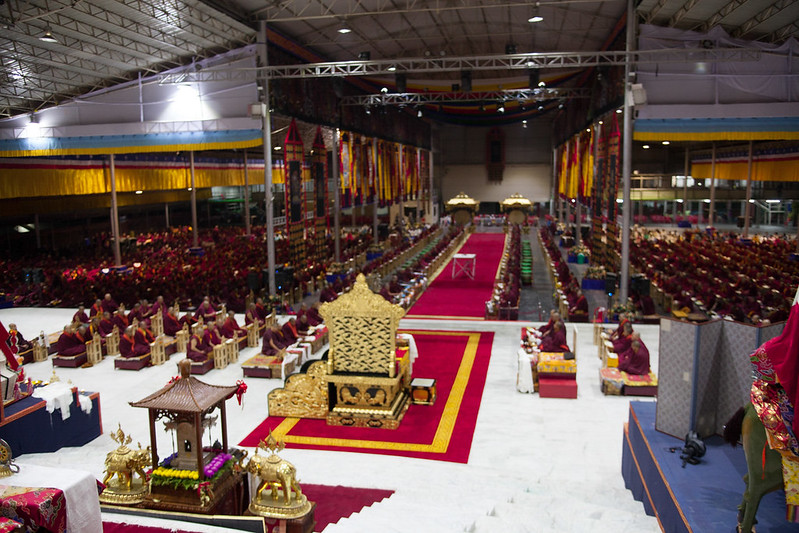
Gyaltsab Rinpoche’s throne was placed directly in front of the Gyalwang Karmapa’s high throne. To the right, on an elegant golden table covered with brocade, sat a delicately wrought silver pavilion.

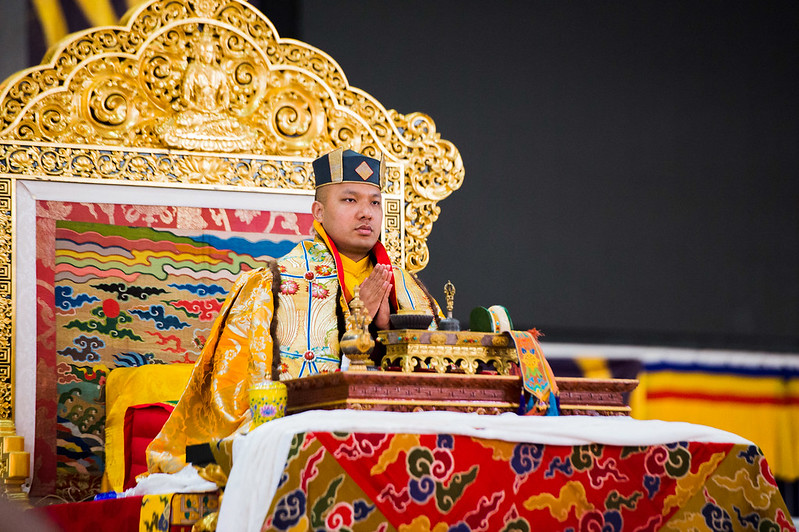
At last the stage was set, the gyalings blew, and the sangha returned from the break to take their seats. After several minutes, the Gyalwang Karmapa led an elderly Theravadin monk from Bangladesh and his small entourage onto the stage. He had come bearing a special gift for the Karmapa, which with reverence His Holiness placed inside the silver pavilion, before taking his seat on a throne to the front right of Gyaltsab Rinpoche’s. At last the time had come for the momentous occasion of the Red Crown ceremony. This would be of special historical importance since it was the first time that a Vajra Crown ceremony had ever been performed in Bodhgaya, the site of Buddha Shakyamuni’s enlightenment. Under instructions from the 17th Karmapa, the 12th Goshir Gyaltsab Rinpoche had agreed to perform the Vajra Crown ceremony this year during the Kagyu Monlam’s extended program.

A Brief History of the Vajra Crown Ceremony

Each lineage of Tibetan Buddhism has its own style of ceremonial hats with their own particular symbolic meanings. The hats can represent the guru, and they may represent the lineage. Sometimes they are symbols of the special noble qualities of the guru himself, as is true of the Gyalwang Karmapa’s Black Crown. 

The Gyalwang Karmapas began the tradition of Vajra Crown ceremonies utilizing the Black Crown, which is particular to them. Karma Pakshi, the Second Gyalwang Karmapa, stated that whoever witnesses the crown ceremony will not fall into the lower realms. Later, various Gyalwang Karmapas bestowed red crowns upon Shamar Rinpoche, Situ Rinpoche, and Gyaltsab Rinpoche.

Thus crown ceremonies became an important aspect of the Kamtsang Kagyu lineage. Beholding the Vajra Crowns is said to grant liberation upon sight. However, this doesn’t mean that one is liberated in the very moment of seeing them, but rather that beholding the crowns plants the seed of future liberation in one’s being.

The Fifth Dalai Lama recounts in his biography of the Third Dalai Lama, Sonam Gyatso, that this master approached Gyalwang Wangchuk Dorje (the Ninth Karmapa), and requested him to perform the Black Crown ceremony. Afterwards, the Dalai Lama asked if he could inspect the vajra crown, and when Wangchuk Dorje handed it to him, the crown remained suspended in space, prompting the Dalai Lama to exclaim that the Black Crown is quite special indeed!

When the crown ceremony is performed, participants are given an opportunity to sponsor the event. There is a tradition of requesting lamas to grant empowerments, teachings, and such ceremonies. Sponsorship is an expression of an individual’s interest in receiving what the lama is offering. Therefore, the opportunity to sponsor the crown ceremony is extended to all would-be participants.

Additionally, special blessing pills are distributed to the sponsors. In general, any of the pills can be taken at any time, and one is enough. They can also be crushed and put in liquids to share with others, including animals. Since these blessings contains very sacred substances blessed by many great masters and have been preserved for many generations, it is important to keep them in a clean place of respect and to take them with devotion.

There are several types of pills that may be distributed during the Vajra Crown Ceremony. The Pills of Immortality are especially beneficial for long life and can be taken at any time, especially when someone is sick. The Four Relics and Other Special Substances contain a vast assortment of blessed substances from the New and Old Schools of Tibet. They can be taken anytime as a general blessing. The Pills of the Seven Births are made of samaya substances and are particularly beneficial to practitioners of the Vajrayana. The Cleansing Pills are meant to remove obstacles and negativity. They can be taken anytime and especially as a cleansing before important retreats or practices. The Resplendent Nectar Dharma Pills are considered extremely sacred and can be used in inner offerings and sacred drink during ganachakras. Further, just tasting a speck of this guarantees that one day one will attain the state buddhahood. The Seven Birth Mani Pills are blessed by masters of the practice of Chenrezig to create a positive connection to develop compassion and benefit beings.

Palchen Choling Labrang’s Elaborate Introduction to the Crown Ceremony

Next, three translators took their places on the right side of the stage to read this special announcement from Gyaltsab Rinpoche’s Labrang:

While gathered here in Bodhgaya, the site of the Bodhi tree under which the 1002 buddhas of this fortunate eon will attain enlightenment, here in this grand Pavilion of the Kagyu Monlam, we would like to offer our respect with body, speech, and mind, to the Sixth Buddha, the Gyalwang Karmapa, Ogyen Drodhul Trinley Dorje, and on behalf of the Palchen Choling Labrang, we would like to welcome and offer all of you Tashi Delek. Tashi Delek to the khenpos, the tulkus, the geshes, lamas, monks and nuns, and especially the Kagyu Monlam committees, as well as all the devotees gathered here.


After the elaborate rituals of the Grand Mahakala Puja or the Tsechu Ritual, there is a tradition of the Gyalwang Karmapa or one of his heart sons performing a Vajra Crown ceremony. Therefore, as the elaborate offerings to the Kagyu Protectors have been auspiciously concluded, per the instructions of the Gyalwang Karmapa, His Eminence Gyaltsab Rinpoche will now perform the Red Vajra Crown Ceremony.


Before His Eminence begins, please allow us to present a brief history of the Vajra Crowns, and the benefits of witnessing the Vajra Crown Ceremony.


Om svasti
Embodiment of the wisdom and compassion of all the victors,
Avalokita at the summit of Mount Potala,
The Glorious Karmapa in the Land of Snow,
I prostrate to him whose fame stretches above all like a white parasol.


Vajrapani, the vajra mind of all the victors,
Ananda, the repository of the victor’s teachings,
Regent of the supreme victor Karmapa,
I prostrate at the feet of the great Goshir Gyaltsapa.


On account of their exceptional resolve and aspirations, the buddhas and bodhisattvas engage in inconceivable awakened activity. Among these acts that are meant to be seen and heard, is the ceremonial donning of vajra crowns. These sacred rituals that plant the seed of liberation upon sight, have ripened and liberated countless disciples. This tradition of performing vajra crown ceremonies, is particular to the practice lineage of the Karma Kamtsang and is exclusive to the Gyalwang Karmapas and his heart sons.


We find reference to crowns in both the vehicle of characteristics, the sutras, and in the vajra vehicle of the tantras. The sutras recount that before Sakyamuni Buddha appeared in this world, he was residing in the god realm of Tushita, where he was known as Lha’i Bu Dampa Tok Karpo. When departing the god realm for this world, he took his crown and he placed it upon the head of the victor Maitreya, thus empowering him as his regent. It is said that Maitreya currently resides in Tushita performing the first of the twelve deeds of the supreme nirmanakaya--teaching to benefit the gods.


In the secret mantrayana, through the crown empowerment of Ratnasambhava, one is enthroned as a great universal ruler, who lords over the three realms, and is placed upon the great lion throne of the utter victory of non-abiding nirvana, free from the extremes of both conditioned existence and peace.


The Black Crown of the glorious Gyalwang Karmapas was presented to him long ago, when he took birth as the sage, Konpa Kye, on the northern side of Mount Meru. At that time the buddhas empowered him with a crown fashioned of single strands of hair from 320 million dakinis. Beings whose obscurations are subtle perceive the Black Crown as ever present above the head of all the incarnations of the Gyalwang Karmapas. But for the benefit of childlike beings ensnared in a thicket of coarse obscurations, a physical Black Crown was fashioned, a symbolic representation of the true crown’s essence, and decorated with various precious gems and a gold blaze.


Each of the Gyalwang Karmapas has heart sons who are actually his emanations. As they are inseparable from him, the Gyalwang Karmapas bestowed upon them vajra crowns and commanded them to accomplish vast benefit for the teachings and beings. Together with his resolve, command of interdependence, and aspirations, the Karmapas enthroned them as Dharma Kings and thus arose the tradition of their vajra crowns.


Goshir Gyaltsab Rinpoche’s red crown originated with a prophecy. The Lotus-born Great Guru Padmasambhava prophesied to the Seventh Gyalwang Karmapa Chödrak Gyatso:


If the agent of the victor’s activity—
The emanation of Karchen Pelgyi Wangchuk
And Dromtön Gyalwe Jungney—
Dons the crown that is the command of the guru,
It will create auspicious conditions
For the Buddha’s teachings to flourish.

Subsequently, a red crown with a golden blaze that liberates upon sight was consecrated through the practice of Lama Gondu. Having been blessed as the essence of vajra speech, Amitabha, it was placed on the head of the 2nd Gyaltsab, Tashi Namgyal.  Gyalwang Chödrak Gyamtso then proclaimed that the mind of the teacher and student had become undifferentiated and he thus appointed Gyaltsab Tashi Namgyal as his regent to turn the wheel of dharma. The Karmapa continued, saying that with the Vajra Crown remaining inseparable from the Gyaltsapas, it will create auspicious conditions to sustain all the Buddha’s teachings in general, and in particular, the long-standing tradition that is the essence of the Practice Lineage. He then recited verses, scattering flowers of auspiciousness.


When witnessing the donning of the Vajra Crown, you should have unwavering faith in the support, the Vajra Crown, and focus one-pointedly on this exalted object. At that time and at all times, one should supplicate with devotion while meditating that the lama is the embodiment of all refuges, and situated above your head. You should sustain the mind’s natural state without altering it, and should strive to train in loving kindness, compassion, and bodhichitta. These are the attitudes to hold during the ceremony itself, and also the benefits of witnessing the ritual.


Those who possess black and red crowns, the Gyalwang Karmapas and their heart sons, are the crown jewels of the teachings and beings. By regarding them as the eyes in your forehead and the hearts in your bodies, you should rouse the three faiths: clear faith, (an utterly lucid mind that is not contaminated by any obscuration of selfish attachment or aversion), the faith that longs to truly manifest the ultimate result, and the faith of conviction welling up from the depths of your being. Giving rise to these, you should sustain the nature of mind itself, and train the mind in loving kindness, compassion, and bodhichitta.


The results of making effort in presenting clouds of offerings, in making supplications and forming aspirations when witnessing the vajra crown ceremony are as follows:


Those of supreme fortune will be granted
The qualities of the paths and levels upon beholding it.
For those of lesser fortune who have accumulated many negative actions,
Witnessing the crown ceremony will eradicate misdeeds and obscurations
Accumulated over thousands of kalpas.
The most desirable things of this life will be obtained according to one’s wishes.
By focusing on and supplicating you,
All hopes will be fulfilled accordingly.


Thus, all qualities of meditative experience and realization will arise without difficulty. All negative karma, misdeeds and obscurations will be dispelled. And all your intentions will be accomplished just as you wish.
May the glorious lama’s lotus feet be firm.
May happiness come to all throughout space.
May I and all others gather the accumulations, remove obscurations,
And swiftly be brought to buddhahood.

Following this auspicious announcement, His Eminence Goshir Gyaltsab Rinpoche performed the Red Crown ceremony twice. At this time, the special blessing pills mentioned above were distributed to the sponsors of the ceremony, after which Rinpoche bestowed the Long Life Empowerment of the Three Roots Combined.
 

20170226_Red Crown Ceremony

The Last Day of the Tibetan Year Begins

Monlam Pavilion, Bodh Gaya

The final day of Gutor for the Year of the Fire Monkey began at 4 in the morning when the stars were still out and the air had a chill in it. People were huddled in down jackets or wrapped up to their eyes in a thick woolen shawl. Jalings from behind the stage announced the Karmapa’s arrival, and after three bows, he took his seat on the black and gold throne to preside over the puja. One could often hear his voice blending in with the chant master’s.

The first text was the short Mahakala practice known as the Cinnabar Mahakala since the first parts to be chanted were marked off in a brilliant red from the long text Burning Up Hostility by the Sixth Karmapa, Thongwa Dönden. At the end of this came a short section known as Receiving the Siddhi. At this time the Nyingzuk, the huge main torma sculpture that represents Mahakala, was carried by several people to give its blessing, first to the Dorje Lopon who has guided the pujas during the entire time. Then it was offered to the Karmapa and Gyaltsap Rinpoche, before being placed back on the shrine.

The early morning’s program finished with an extensive smoke offering, known as Massive Clouds of Amrita, during which vast offerings imagined as filling the entire sky were made to every imaginable yidam deity, lamas, dakinis, Dharma protectors, and local deities of all kinds—a grand finale of offering and thanks to everyone.

20170226AM_Vermi lion Mahakala

20170226AM_Smoke Offerings Massing Clouds of Amrita Garsang

The Arya Kshema Incense Project Continues for a Second Year


Monlam Pavilion — January 22nd - February 19th, 2017

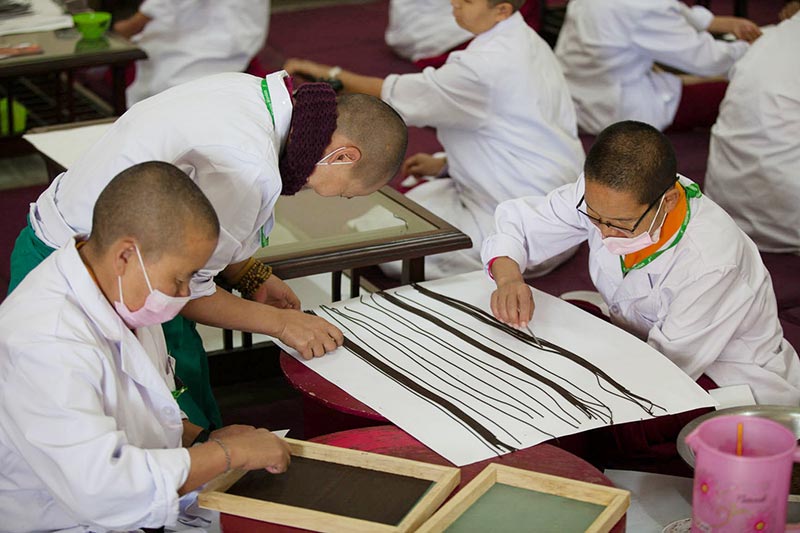
Last year 17 nuns from different Kagyu nunneries were the first cohort to join a special workshop in which they learned how to make high-quality Chinese incense. This year the focus changed to producing high-quality Tibetan incense using traditional methods, and the training period, previously three weeks, was extended to four.  Ten nuns from last year’s training and five new students came to study this skill with Tibetan Doctor Dr Dawa, assisted by Ru-Ruei Chung, a professional Chinese incense maker from Taiwan who taught the course last year.

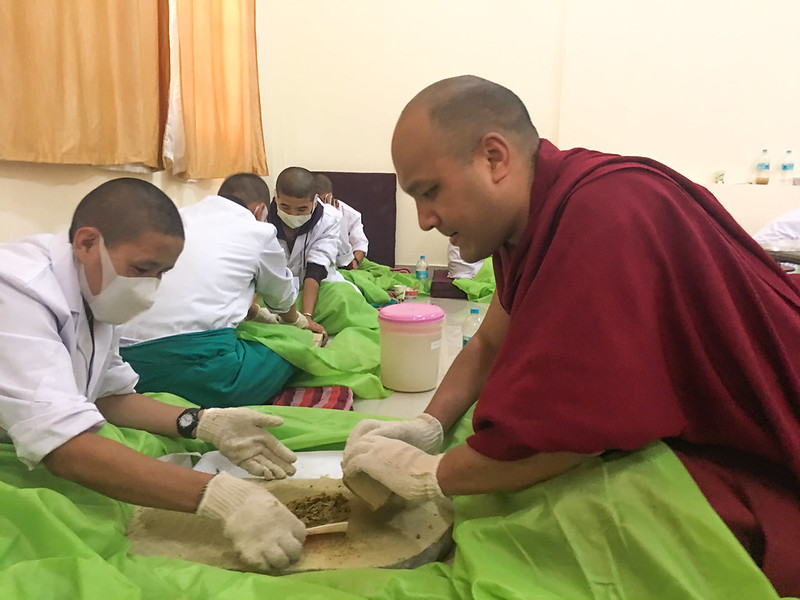
The project was based in a large airy room at the back of the Monlam Pavilion, and the nuns wore overalls, facemasks and gloves for protection against the dust and to keep the environment in which the incense is being made as clean as possible.

The first part of the process was the hardest. All the ingredients had to be ground by hand using traditional methods. For the first nine days of the project, the nuns ground the ingredients using a large, round stone on a stone working surface. Ani Janchup Drolma, the Chinese –Tibetan translator, commented,

"This was very hard work. The nuns got blisters which broke and then they had very sore hands.”

However, the Gyalwang Karmapa visited the project nearly every day to speak with the nuns and assist them in the work. Not only did he encourage them by saying how well they were doing, but he even helped them grind the ingredients by hand himself. The nuns explained that His Holiness’s involvement and support gave them the enthusiasm and determination to keep going when the work was difficult or they felt tired.

Next, the ground ingredients had to be mixed together. Then they were rolled by hand, cut to size, packed in boxes and dried in the sun.

Two qualities of incense were made this year. The less expensive one was made from just two ingredients: cedar and white Himalayan rhododendron. The more expensive one contains thirteen medicinal herbs and substances including nagi, cloves, cardamom, Kashmiri saffron, white sala and bdellium, and is based on an old recipe recorded in the Sorig Patra by Deumar Geshe Tenzin Phuntsok, a highly-respected physician in 18th century Tibet.

Both incenses have been made using the highest quality, pure ingredients gathered from the Himalayan regions of India, Nepal, Bhutan and Tibet.

This year the nuns made four different products in total. As well as the incense, they made a quality chilli spice powder from ground red chilli, black pepper and cumin, and they also made an incense powder which can be used in smoke offerings.

In total, the nuns produced 1600 boxes of incense and 133 small jars of chilli spice powder. All the proceeds from the sales of these products will go towards education for Karma Kagyu nuns, and, because this year’s project was scheduled differently, an added bonus for the nuns themselves is that this year they will be able to join the Arya Kshema teachings and debates in March 2017.

Click here to view the Arya Kshema Incense Project Picture Story.


20170225_Special Incenes making by nuns

The Great Cham Dance


Monlam Pavillion

The ritual preceding the Cham—an offering of the Fifth Shamar’s abridged form of the Sixth Karmapa’s text Incinerating the Hostile—began at 11.00pm on the 24th February. Vigorous chanting accompanied by the beat of both large temple drums and  hand-held drums, punctuated by a crescendo of cymbals, gyalins, great horns and the wailing of kanglins [thigh-bone trumpets] could be heard all night across the vast grounds of the Garchen, the Monlam Pavilion and Tergar Monastery.  Finally, at 5.30am the ritual finished, exactly on time.

The stage was set for the next major event of the Gutor, the great Cham dance.


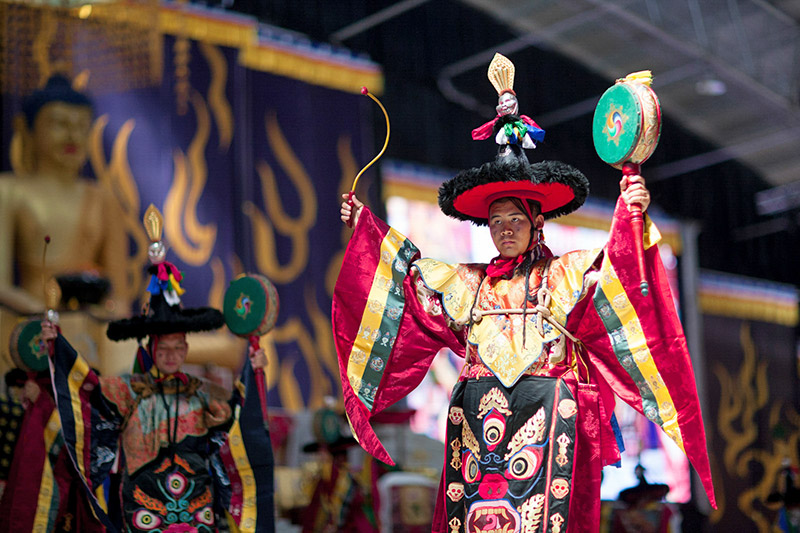
On one level this ritual dance, unique to Tibetan Buddhism and performed only by monastics, might seem a colourful spectacle set to a strange cacophony of instruments, drums, and the human voice. In fact, within the Tibetan Buddhist world, Cham is far from entertainment. Rather it is a profound form of meditation which opens up the possibility of experiencing the sacred. For the audience, It falls into a category of spiritual experience known as thongdrol in which the veils which obscure the clear light of the natural state of mind momentarily fall away to give a glimpse of the true nature of phenomena. For the dancers, it is a prolonged meditation in which they visualise themselves as the deity or Dharma protector.

Both the performers and the audience are intended to approach the dance in a meditative state.

At 6.30am, the Gyalwang Karmapa, seated on stage wearing his black activity hat, blessed all the dancers who would take part one-by-one. While they changed into their costumes, His Holiness spoke to the audience about the Cham dance they were about to see. He explained:

As the dancers are imagining themselves as the deity, they think that all the physical motions they make are the expressions of the deity or the deity’s motions. Likewise, the spectators of a lama dance should not think of lama dancing as an ordinary performance or ordinary dance. If you know how to practice the mantra, it is important to train in the pure perception connected with tantric practice and think that you are actually seeing the deity, meditating on faith. Purifying ourselves of the fixation on ordinary appearances is of primary importance in the mantra, so it is very important for the performers of lama dance to try to block the fixation on ordinary appearances and for the spectators as well to put effort into blocking fixation on ordinary appearances.

The Karmapa then gave details of the history and significance of the three major dances to be performed during the day, pointing out that today was unusual in that:

Today during the first dance, the Female Guardians of the Gate, a few extra dances will be inserted in order to restore any violations of samaya. When the Black Hat Drum Dance is performed at Tsurphu Monastery in Tibet, the Female Guardians of the Gate and Shingkyong are not usually performed along with it, but today is different and we will perform the Female Guardians at the beginning and Shingkyong at the end.

The Gyalwang Karmapa observed the dances from the penultimate tier on the right wing of the stage. Seated next to him were Goshir Gyaltsab Rinpoche, Yongey Mingyur Rinpoche, Shiwa Lha Rinpoche, and Bokar Yangsi Rinpoche, opposite him, on the left wing with the musicians, in perfect symmetry, sat the young Drupon Dechen Rinpoche, reincarnation of the abbot of Tsurphu.

But before the Cham began, the great Hazhel torma was escorted in a great procession by monks from Rumtek Monastery and lay members of Tsurphu Labrang from its booth onto a platform at the front of the stage . The Vajra Master, dressed as the Go-Ma (Guardian of the Gate), swirled a black cloth to keep any spirits from escaping as the Hazhel was moved.

Then began the Go-Ma Cham, a solo dance by the Vajra Master from Rumtek Monastery, representing the Four Female Gatekeepers. Each gatekeeper has a different weapon to ensnare the ‘enemy’ of ego-clinging and thrust it into the effigy at her feet, concealed by a red cloth. It is caught with a hook, captured with a lasso, bound in chains, and intoxicated with the sound of the bell. This effigy will be burnt later along with the Hazhel. As the Karmapa had said, the Go-Ma dance this year also incorporated the Deer Dance, the Dance of the Demons, and the Skeleton Dance.  The latter are the four Lords of the Charnel Ground.  Immediately they appear, the music changes, clashes of cymbals transform into the jangle of jiggling bones. The tight-fitting costumes marked with lines for bones are quite life-like, particularly the red-gloved hands, empty fingers  dangling and painted white to resemble finger bones.  Reminders of the Chöd practice, these skeletons too are warriors in the battle against ego-clinging.

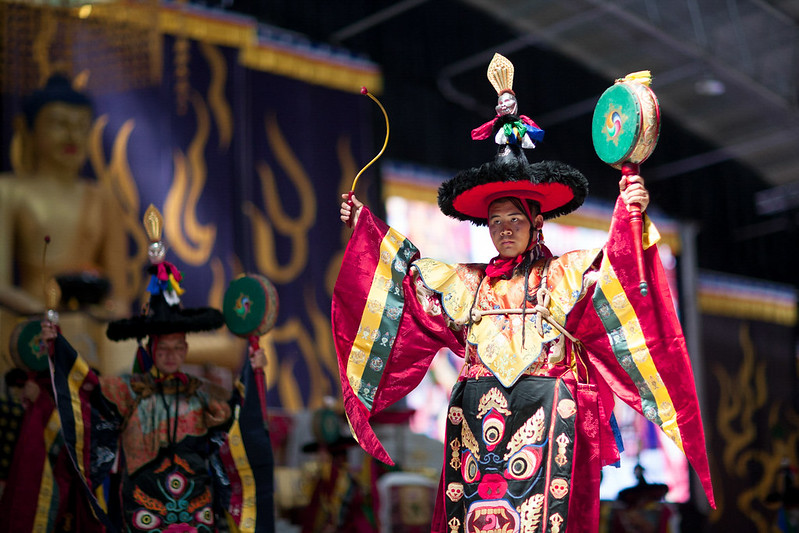
The second major dance was the Black Hat Drum Dance performed by Benchen Monastery. It was to be the principal dance of the day and took more han five hours to perform. Based on a pure vision of Mahakala experienced by the Sixth Karmapa Thongwa Dönden, when he was only six or seven years old, the dance originated at Tsurphu and became part of the Karma Kamtsang tradition. As the 17th Karmapa pointed out:

If you watch the dance closely, you will see that there are some child-like movements, and this is because he choreographed it when he was just a child.

Additionally, this was an historic occasion:

This the first time that the great Mahakala Puja—the longest Mahakala puja—and Black Hat Drum Dance choreographed by the Sixth Karmapa Thongwa Dönden have been  performed together in the Noble Land of India. You could also safely say that it probably also hasn’t happened in Tibet either for two or three hundred years.

The tradition of the dance was almost lost following the disaster which befell Tibet in 1959. Fortunately, the lineage of the dance was preserved in Tibet at TsaTsa Monastery and  in exile by Tenga Rinpoche at Benchen Monastery, Nepal. It was Tenga Rinpoche who learned that the dance had been preserved at Tsa Tsa Monastery, near Derge in Kham, and suggested that the Karmapa contact them.  After some research, it was discovered that there were some differences between the Benchen and TsaTsa versions of the dance, but as TsaTsa had all the text and instructions complete with a history of the lineage which proved  it came from Tsurphu, they had decided to follow the TsaTsa tradition. Tsa Tsa Monastery had then sent a video of the dance for the Karmapa to study. In this way, it had been possible to follow the authentic tradition and revive it at Benchen.

Because it takes so long and requires so much energy, the dance was punctuated by short breaks during which the dancers were fed saffron rice and rich Tibetan butter tea to keep their strength up.

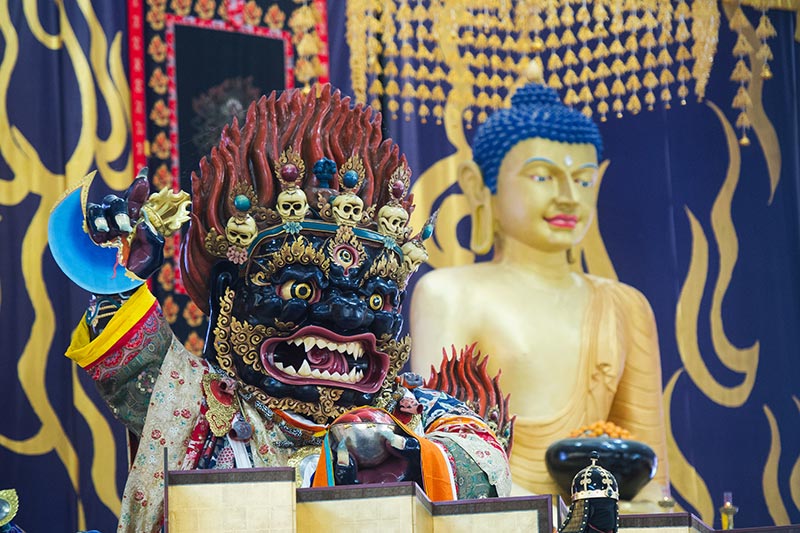
Just after 2.00pm, the covers on the Mahakala and Mahakali images were removed so that the Gyalwang Karmapa assisted by Goshir Gyaltsab Rinpoche could make the libation offering—the serkyem. His Holiness threw the great cup—attached to coloured ribbons of green, blue, white, yellow and red, signifying the five Buddha families—high into the lap of the magnificent Mahakala.

The end of the Black Hat Drum Dance segued without a break into the Dance of Throwing the Torma. This Cham was choreographed by the Third Karmapa Rangjung Dorje, based on the Mamo Tantra from the Nyingma tradition.

Then began the final rituals involving the Hazhel torma. The Black Hat Dancers with Drums danced down the aisle, facing this way and then that, as far as the entrance to the pavilion but no further. The great Hazhel of Mahakala, carried on a pallet by twelve monks, made its way slowly in a grand procession out of the Monlam Pavilion and into a field at the back, where a twenty-foot-high, triangular pyramid of hay had been prepared. It was placed inside the pyramid along with the effigy and invocations were chanted. At this point, the concentrated power of the Hazhel was released in an explosion of spiritual power  known as the torma attack. This destroys the accumulation of negativity and obstacles ‘trapped’ in the effigy. The pyramid was set on fire and immediately burned fiercely. As long tongues of flame leapt out, spectators backed away. Swiftly, the blaze reduced the Hazhel and the effigy to a pile of ash.

The final dance of the Cham, Shingkyong, was performed by a second group of monks from Benchen Monastery. Shingkyong is the lion-faced protector in the retinue of Four-Armed Mahakala. He is said to be an emanation of Chakrasamvara and of Four-Armed Mahakala, and became a protector of the Karma Kamtsang during the time of Karma Pakshi.

However, there was a specific reason why Benchen Monastery performed the dance. As His Holiness explained:

Shingkyong is considered a particular, important protector of Benchen monastery. So I have asked them to perform Shingkyong today so that the rebirth of Kyabje Tenga Rinpoche may return quickly and to pacify all the omens of obstacles to that occurring.

Since the previous Monlam, the monks of Benchen Monastery have been engaged in various pujas prescribed by His Holiness to remove these obstacles, and everyone prayed that through the positive effect of these different activities Rinpoche’s reincarnation could now be found.


20170225_Torma Attack Procession&Cham&Concluding ritual

The Mahakala Night

February 24/25 2017

The night session of the Mahakala puja started at 11 p.m. The pavilion was covered in deep blue drapery inscribed with golden, fiery imagery allusive of the brilliant wisdom blazing through emptiness. The blackened atmosphere of the interior blended into singularity with the quiet night outside.

Along with 5,000 monks and nuns in their usual places, about 300 determined lay practitioners remained to practice throughout the night. This night’s ritual text is called the Abridged Incinerating the Hostile (Dang ba rnam sreg las btus pa), also known as the Golden One. Rather than inducing sleep, this kind of night, with the powerful sounds of chanting and drumming, was meant to evoke lucidity and wakefulness.

Below the main statue of Buddha Shakyamuni, statues of Mahakala, Mahakali and Dorje Lekpa were guarded by an impressive, black armour flanked by golden weaponry, as if strategically placed to wage war on all human drama. The scene was reminiscent of the legend of the great protector Mahakala. The story says that his name was Gelong Deway Khorlo (Bhikshu Wheel of Joy) who belonged to the retinue of a previous Buddha named Sangye Tsuktorchan (Buddha with an Ushnisha). Having developed special cognitions and ability to perform miracles, the proud bhikshu competed with the Buddha and, naturally, lost. That caused him great disappointment, so the god Shiva appeared to him and said: “If you pray to be born as my son, I will give you dominion over the three realms.” Driven by his desire for victory, he prayed to Shiva to fulfill the prophecy. The Buddha knew of this and told him: “Except for some temporary happiness, being born as Shiva’s son has little benefit.” When the bhikshu confessed his faults, the Buddha rectified the prophecy of power into that of enlightenment saying that the bhikshu Wheel of Joy will indeed be reborn as Shiva’s son but he will generate the resolve to be fully awakened in order to benefit others and will eventually become enlightened as the Buddha Telway Wangpo. Just as the Buddha predicted, a son with very dark skin and terrifying appearance was born to Shiva and Umadevi. He possessed great power and was given the name Mahakala, the Great Black One.

The potent sounds of drums in the Pavilion exuded a sense of resoluteness calling to mind a different night of resoluteness above all other, right here in Bodhgaya. It was the night that removed the darkness of ignorance when Siddhartha Gautama sat under a tree and vowed: “Though my skin, my nerves and my bones shall waste away and my life blood go dry, I will not leave this seat until I have attained the highest wisdom, called supreme enlightenment, that leads to everlasting happiness.”

Firstly, the god Mara sent armies of temptations but Gautama did not move and, following Mara’s defeat, in the first part of the night came memories of all his past lives and in the second, the realization of truth. Once the morning star arose, it was all over. He was the awakened one.

Mahakala, who had wandered the three realms by then, came to Bodhgaya after Buddha’s awakening and made the commitment to guard the Buddha's teachings, thus becoming a powerful protector for those on the path to enlightenment.

The puja in the Pavilion continued throughout the cool night as the practitioners chanted and meditated wrapped up in blankets and jackets. Before the morning sun would bring the warmth of blessings with the familiar, powerful presence of the 17th Karmapa Ogyen Trinley Dorje, those who aspired for the benefit of others would remain in meditative poise and, with the practices of the great protector Mahakala, revel in the sea of darkness and delight.


20170224PM~20170225AM_Overnight puja