









KM-banner1.jpg
KM-banner9.jpg
KM-banner10.jpg
KM-banner11.jpg
KM-banner12.jpg
KM-banner13.jpg
KM-banner14.jpg
KM-banner15.jpg
KM-banner16.jpg
KM-banner25.jpg
KM-banner24.jpg
KM-banner23.jpg
KM-banner22.jpg
KM-banner21.jpg
KM-banner20.jpg
KM-banner2.jpg
KM-banner19.jpg
KM-banner18.jpg
KM-banner17.jpg
KM-banner26.jpg
KM-banner27.jpg
KM-banner28.jpg
KM-banner29.jpg
KM-banner3.jpg
KM-banner30.jpg
KM-banner31.jpg
KM-banner4.jpg
KM-banner5.jpg
KM-banner6.jpg
KM-banner8.jpg
KM-banner7.jpg
Shadow

“What I Give Away is Mine”: the Gyalwang Karmapa’s Advice as the 34th Kagyu Monlam Ends

Monlam Pavilion, Bodhgaya

The last afternoon of the 34th Kagyu Mönlam started slightly earlier than usual with a Medicine Buddha tsok practice according to the Concise Ritual of Offering to the Seven Tathagatas, compiled by the 6th Sharmapa. Tsok, in the form of small bags of fruit, was distributed to each and every participant, sangha and lay followers alike, and money offerings traditionally known in Tibet as 'kunki' were also given to the sangha.

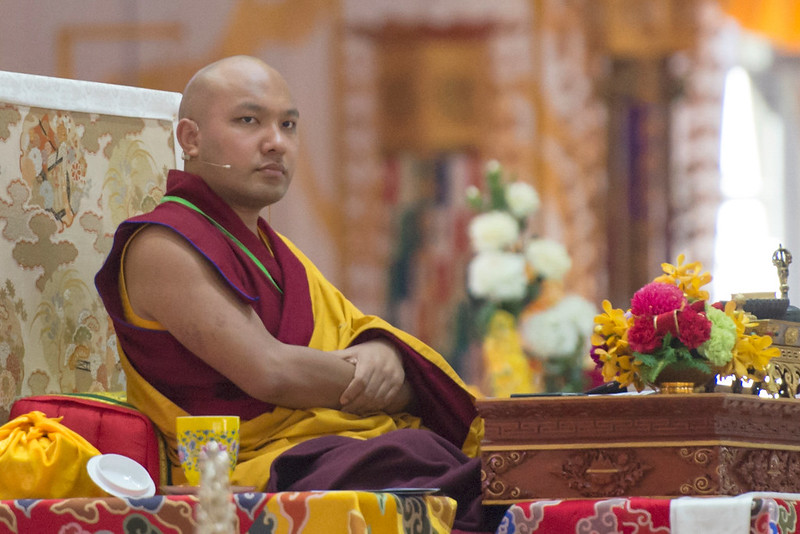
At the end of the afternoon break, His Holiness Karmapa came onto the stage and the session on the Appreciation of the Sponsors opened with the procession for the mandala offering, led by the sponsors who then sat on the stage for the blessings that would follow. Appreciation of the Sponsors is an opportunity to share and dedicate virtue, and His Holiness spoke at some length on the importance of generosity as a means for generating virtue, and on the equal indispensability of the dedication of the virtue generated.

Reprising teachings by Chandrakirti in Entering the Middle Way, he pointed out that wealth and prosperity cannot come about through just any cause, but have their roots precisely in generosity. His Holiness also quoted the Sutra Requested by the Householder Draksulchen on the innumerable benefits of giving: "What I give away is mine, what is left in the house is not. What I give away has meaning, what I keep has no meaning."

That is, when we give things away the virtue generated subsists into the next life, whereas whatever we grasp we must leave behind when we die, he explained. However, virtue accumulated, if not dedicated, may be destroyed through unskillful responses such as anger, wrong views, regret, denigration, and pride and boastfulness about our own generosity. His Holiness used the simile of the drop in the ocean, which remains until the whole ocean dries up, to illustrate that virtue dedicated to bodhichitta is not wasted until enlightenment; and further quotes from Shantideva, Maitreya and the Kriya tantras, to argue that all virtue dedicated, whether ours or others', increases and becomes itself a cause for achieving Buddhahood: "Many rivers flow, each with its own flavour, yet when they reach the ocean, they all taste of ocean."

Recollecting that the scope of generosity depended on the greatness of the recipient, of the thing offered, and of the intention, His Holiness pointed out that the Kagyu Mönlam offered an unexcelled field of offering under all three aspects. Stressing the pure motivation of bodhichitta, he exhorted all Mönlam participants to avoid stains such as the wish for fame, expectations of a return or of riches in the next life, or giving out of envy or prideful conceit. He also said:

The greatest recipients of generosity are the Three Jewels, especially the noble sangha. In generosity to sangha there is virtue in offering and in accepting. Here in the Mönlam there is great virtue, here is gathered the virtue of the three times for us to dedicate.

His Holiness especially commended Goshir Gyaltsab Rinpoche for his sponsoring of the Mönlam, making it worthy of dedication. And certainly the attendance of Goshir Gyaltsab Rinpoche, Yongey Mingyur Rinpoche and Yangsi Bokar Rinpoche in this last afternoon, as in the previous days of the Mönlam, heightened the participants' sense of the auspiciousness of the occasion.

The essential proceedings of the Appreciation of the Sponsors then got under way: in synch with the chanting of the Offering of the Eight Auspicious Substances, the Offering of the Seven Articles of Royalty, and the Offering of the Eight Marks of Auspiciousness, their representations were successively brought to His Holiness to be blessed, and taken round to the sponsors to bless them in turn. In conclusion, extolling once again the virtue of sharing in the benefits of the sponsors, His Holiness offered a statue of the Buddha to each of them, and gifts were also made to the sangha present on stage.

His Holiness, although suffering from a bad cold and lack of sleep, used the platform of his closing address to the 34th Kagyu Mönlam to speak honestly and openly about the situation arisen with Jamgön Kongtrul Rinpoche's resignation. He explained that he had learned about it shortly after it had happened, a few months before it became public; that himself and others around him and in the Jamgön Labrang who were aware of it tried to do all they could, until Rinpoche announced it himself on Facebook. He shared a particular feeling he'd had when celebrating Rinpoche's birthday:

"I thought that Rinpoche was separated from his parents and brought to India at a very young age—before the age of one. From the time he was very young, he had a lot of difficulties. I thought, 'How dreadful. The poor guy!' I’d never had that thought about him before, but I did last year.

He was given the title of a tulku, and of a high lama in particular, and because of that he probably has the same feelings about the difficulties he faces as I do. It has been many years since I was given the title of Karmapa, and I have experienced many difficulties myself."

His Holiness expressed his great regret that he had not been able to give greater support and advice:

"Often I was unable to show Rinpoche how I cared for him. So I would like to take this opportunity to apologise to Rinpoche, the Jamgön Labrang, and all the students who are connected with him."

When the situation first arose, His Holiness acknowledged, he had many different feelings, he was angry and depressed. But he stressed that he had never given up on Rinpoche, nor on his love and care for him. He expressed his certainty that all who had faith in Rinpoche felt the same, and this was something he would like Rinpoche to understand. Jamgön Kongtrul Rinpoche's resignation was, nonetheless, a great setback for the Kagyu lineage:

The previous Jamgön Kongtrul Rinpoche's passing away at a young age created difficulties, this adds even more difficulties on top of that. I'm sure that the Jamgön Labrang did all they could with pure motivation, so I ask the Labrang and sangha not to get discouraged. I also ask the students, friends and sponsors of the Jamgön Labrang to continue with their support, so that the activity of the various Jamgön Kongtrul incarnations can increase.

Many people might be worried about what would happen in the future, but the important thing to remember for a tulku, His Holiness counselled, was to never give up on the teachings of the Buddha. Wrapping up his address, he reiterated that whether Rinpoche was a monk or not, he should not give up working for sentient beings, and that the same held true for the lamas and tulkus who were in the world, in whatever situation:

That’s about all there is to say. I have done everything I could up to now. I’m not someone who has abandoned all faults and developed all qualities. But no matter what happens, I continue to think I won’t give up on benefitting Buddhism and sentient beings. Please everyone keep that in mind.

After the reading of the Great Aspiration and of the Dedication for the Living and Deceased—and a reminder that it was through the sponsoring of these prayers that the Mönlam was made possible—His Holiness took the time to extensively thank all those whose contribution had ensured a successful 34th Kagyu Mönlam: Lama Chodrak, and all the tulkus who had worked very hard alongside everyone else; Tergar Monastery, Yongey Mingyur Rinpoche and all the workers there who had offered 100% support; the Kagyu Gunchoe, whose workers had become Mönlam workers too; and the workers from the Tsurphu Labrang who, whether operating in ordinary circumstances or in the whirlwind of the Mönlam, made everything possible for it to go well.

His Holiness also expressly mentioned the representatives of the Tibetan and Indian governments, pointing out that they travelled with him all the time, and that it was appropriate to take this opportunity to thank them. He again thanked the Mönlam Members and the guru sevakas; for the latter, in particular, His Holiness appreciated the hardships they faced making their way to the Mönlam, and how very hard they worked, throughout, once there. He thanked the students from Suja School in Bir who had come to work as the dharmapalas, and the Indian workers who were there every day. And he left some special thanks for last:

Thank you, Gyaltsab Rinpoche, for coming and presiding over ceremonies. Thank you, Mingyur Rinpoche, for your hospitality and your blessings. Thank you, Bokar Rinpoche, for being here, your predecessor was a life force of the Mönlam.


I would like to thank all the tulkus, all the teachers, and all the sangha from our monasteries and nunneries and from other lineages. I thank you from the bottom of my heart. Over 50 countries are represented here and I thank you all for coming. We are realising the noble wish of the 7th Karmapa by coming together to pray. Every one of you, I thank you all.

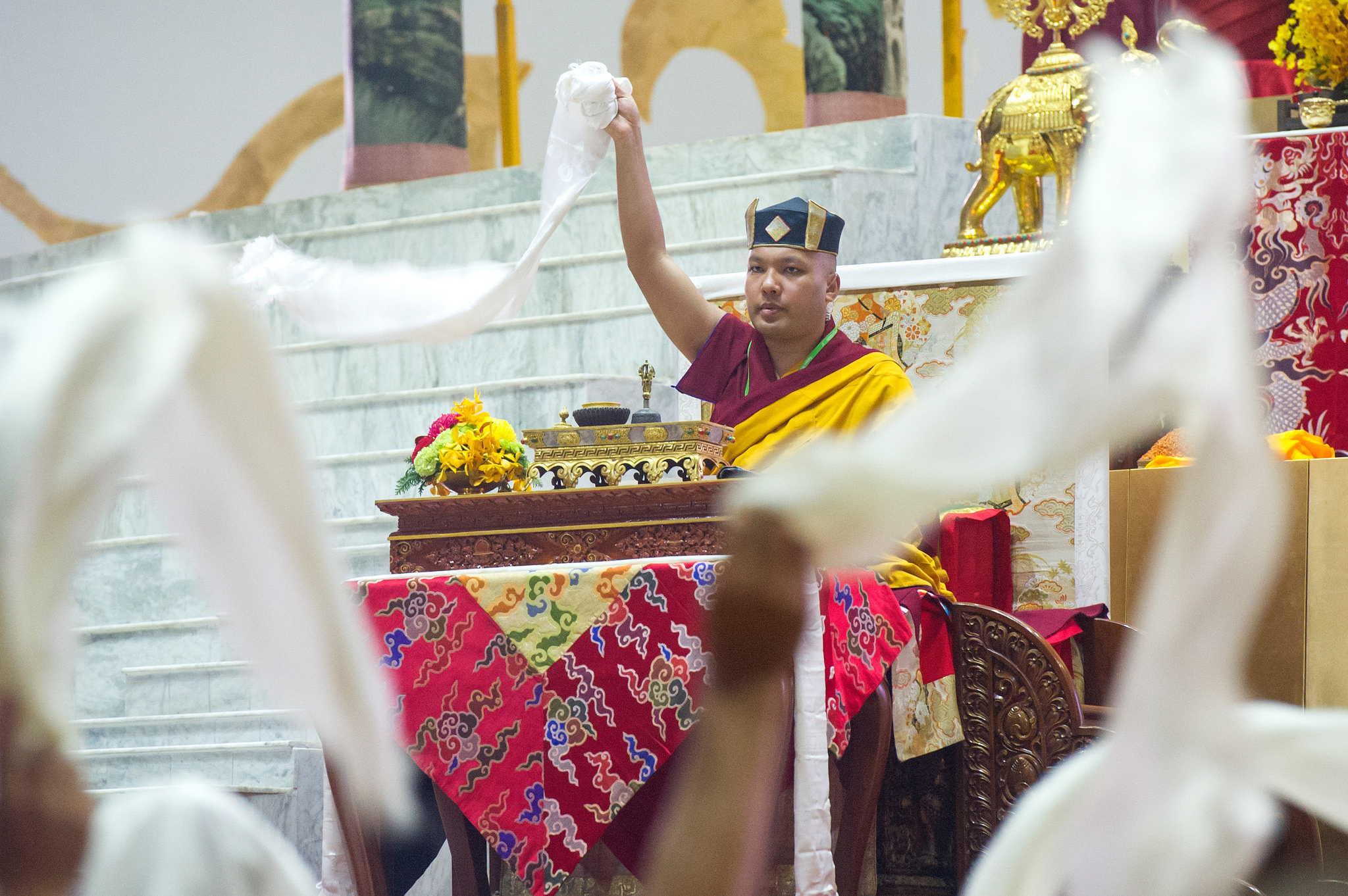
The 34th Kagyu Mönlam ended with images of beauty and unity in aspiration that could not but make a deep and lingering impression in the minds of all present. At every refrain in Lord Marpa's Song of Auspicioness, in the Auspiciousness of the Great Encampment, and in the final Prayers to Accomplish the Truth, Mönlam participants waved their katas in ripples of unison, firstly accompanied by the Karmapa's throwing of rice in blessing, and then led by the unfurling of his own white kata. At a last sustained call of jalings and dungchens, His Holiness left the Mönlam stage, and the curtain fell on the intensity of this unique week.
20170219PM_Offerings to the gurus,Medicine Buddha,Sponsor Appreciation,HHKs Closing Speech

Celebrating the Life of the Eighth Kyabje Dorzong Rinpoche: A Ritual of Offerings to the Gurus


Monlam Pavilion, Bodhgaya

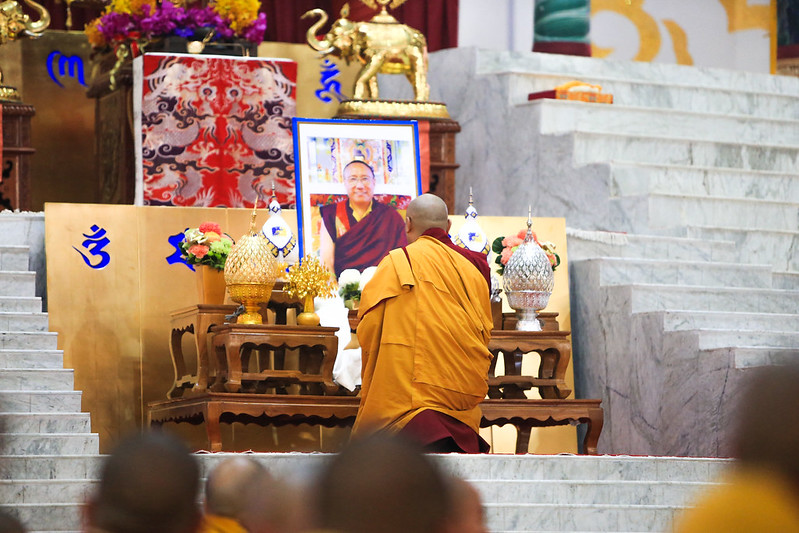
The extensive Ritual of Offerings to the Gurus, always performed on the last day of the Kagyu Monlam Chenmo, was composed in 2005 by His Holiness the 17th Karmapa. It is a compilation drawn from many famous Buddhist texts.  The puja often serves as a memorial to a particular Lama who has passed away, and this year a large portrait photograph of the Eighth Kyabje Dorzong Rinpoche was placed centrally below the shrine.

The stage had been rearranged following the Sixteen Arhat and Alms Procession the previous day. Four of the victory banners from that procession remained on the top tier of the stage, and the others were arrayed in the wings. Below them, three tiers of heavily laden offering tables stood to left and right of the pagoda shrine containing the infant Buddha.  The bottom tier was replete with pyramids of fruit— black and green grapes, oranges, melons, and different types of apple. The middle tier held the seven symbols of royalty and the eight symbols of auspiciousness, and the top tier held the eight auspicious substances. These were to be used in the afternoon.

As the Lama Choepa began, in a symmetry of action, the Gyalwang Karmapa assumed the role of ritual master. Standing in front of the shrine to the infant Buddha, he made the offerings on behalf of everyone, as he had on the first morning. In an innovative ceremony, the reception of the Cotton-Clad monks was incorporated into this part of the ritual. (See report: Reviving the Tradition of the Cotton-Clad Yogis.)

Having completed making the offerings, His Holiness lit candles in front of the photo of Kyabje Dorzong Rinpoche and sat in meditation for a while.

The Eighth Kyabje Dorzong Rinpoche established the Dorzong Monastic Institute Jangchub Jong at Gopalpur H.P., and also maintained Dorzong Monastery in Tibet. Dorzong Rinpoche, a devoted student of His Holiness the 16th Karmapa Rigpe Dorje, had  been very supportive and shown great kindness to the 17th Karmapa  and his sister after they came to India. When His Holiness the Dalai Lama inaugurated the Dorzong Monastic Institute in September 2010, Rinpoche invited the 17th Karmapa as the guest of honour. Kyabje Dorzong Rinpoche was the tutor of the Ninth Khamtrul Rinpoche and both attended the two-month- long transmission of the Kangyur given by HE Sangye Nyenpa Rinpoche in the Karmapa’s private quarters in Autumn 2011.  Further, in October 2012, when the Karmapa gave a Chöd empowerment and teaching, it was hosted by Rinpoche at the Dorzong Monastic Institute. At that time, Rinpoche declared:

“Along with the previous and present Kyabje Khamtrul Rinpoche of Tashi Jong, His Holiness the 16th Gyalwang Karmapa was one of my outstanding root gurus. I am extremely pleased to be able to host His Holiness the 17th Karmapa, Ogyen Trinley Dorje, who is also my root guru.”

Dorzong Rinpoche had been ill with cancer for some time. At first, it had seemed he was recovering but in October 2016 his condition began to deteriorate and steadily worsened. At the end of January, the Karmapa spoke with Rinpoche in Delhi and arranged for his medical evacuation to a famous hospital in Taiwan, where he was treated with both Chinese and allopathic medicine. Once more his health began to improve, but on 15th February 2017, when further complications arose, Rinpoche asked to be transferred to the local Thrangu Dharma Centre, where, on 16th February, to the chanting of the Mahamudra Prayer, he assumed the bodhisattva posture and entered the meditative state of thugdam. On February 19th, while his great contribution to the Dharma and to the benefit of sentient beings was being commemorated at the Kagyu Monlam, he was still in thugdam.

His Holiness slipped away during the morning session to visit the Mahabodhi Temple in order to make further offerings for auspiciousness on the final day of the Monlam. He returned later to conclude the session.

In the afternoon, during the closing session of the Monlam, everyone joined in chanting three times a special prayer which the Karmapa had written, a supplication for the swift return of Dorzong Rinpoche’s reincarnation.

“Dorzong Rinpoche passed away,“ he said. “I have tried to compose a prayer. Perhaps it is not so beautiful but the words have come from my heart.”

20170219AM_Offerings to the Gurus; Dorzong Rinpoche

Reviving the Tradition of the Cotton-Clad Yogis

Monlam Pavilion, Bodh Gaya

The source for all practices and traditions that are followed at the Kagyu Monlam is the Seventh Karmapa, Chödrak Gyatso (1454-1506). In a letter to Minyak Gang Monastery in Kham, Chödrak Gyatso described how to combine the practices of the Six Yogas with the Monlam they were practicing. The letter detailed what to do, which texts to chant, and the practice of wearing the white cloth (ras bud byed pa). Usually the term cotton-clad (ras pa) refers to the followers of Milarepa (Mi la ras pa) who were mountain yogis and yoginis clad in white cloth. The other Kagyu tradition of Gampopa is for ordained monks who wear burgundy robes.

Evoking the tradition of Milarepa, a particular practice of wearing white cloth occurs at the end of a three-year retreat, and also in some monasteries on special days, such as the combined death anniversary of Marpa (the fourteenth of the first Tibetan month) and Milarepa (the fifteenth of that month). During the traditional three-year retreat, meditators practice tummo—one of the Six Yogas of Naropa and a special practice of Milarepa. It involves generating body heat to overcome the experience of cold. When they end their three-year retreat, the retreatants wear a wet, white cotton cloth, which they should dry with their body heat to demonstrate their success in tummo.

Up until now, this element had been lacking in the Kagyu Monlam performed in Bodh Gaya, so the Karmapa decided that it should be revived this year and continue as a part of the yearly gathering. Prior to tummo practice, the retreatants must engage in vigorous yogic exercises, usually for a month but there was not enough time in the program this year, so they practiced for a week from February 12 to 19 in the main shrine hall of Tergar Monastery. These yogic practices are always done in secret, because spectators could disturb the meditators, leading to broken bones, and for those who look, obstacles could come. All the windows of the hall, therefore, were covered with thick cloth, and sentries were posted around it.

Inside the hall, thick mats, a meter and a half square, were laid out in a spacious formality for the 110 meditators. There were many candidates for the practice, and to make it easy, this year it was decided that it would be for monks who had completed a three-year retreat in the tradition of the Six Yogas of Naropa. They should also be under sixty years old, since above that, the yogas do not turn out so well. To teach and remind the older retreatants of the practices, the retreat masters also participated.

In his letter to Minyak Gang Monastery, the Seventh Karmapa had also noted: “Even though there is no difference in the wearing of the white cotton cloth as it is practiced in the traditions of Naropa or Niguma, we should follow Naropa’s tradition since it has special qualities.” The Six Yogas of Niguma is practiced in the Shangpa Kagyu tradition, and since the Karmapa wished to include these yogis in the Monlam, a special area for them was curtained off in the shrine hall, because the practitioners of these two traditions should not see each other’s yogic exercises.

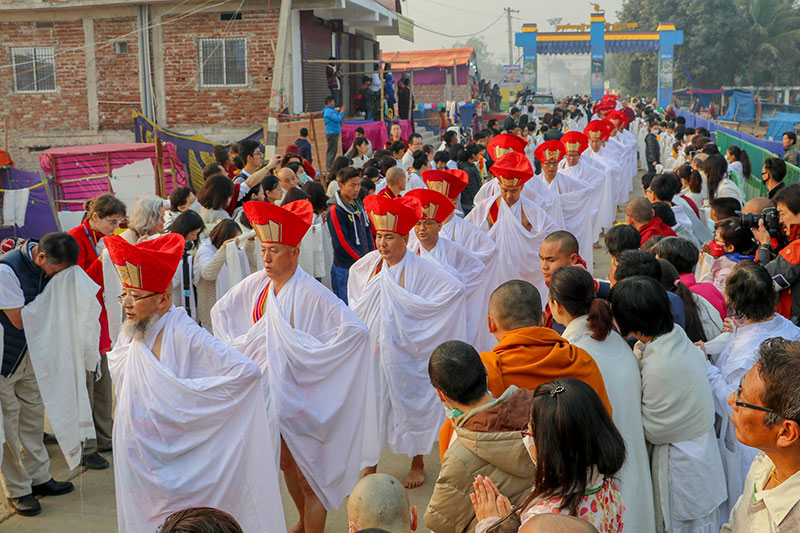
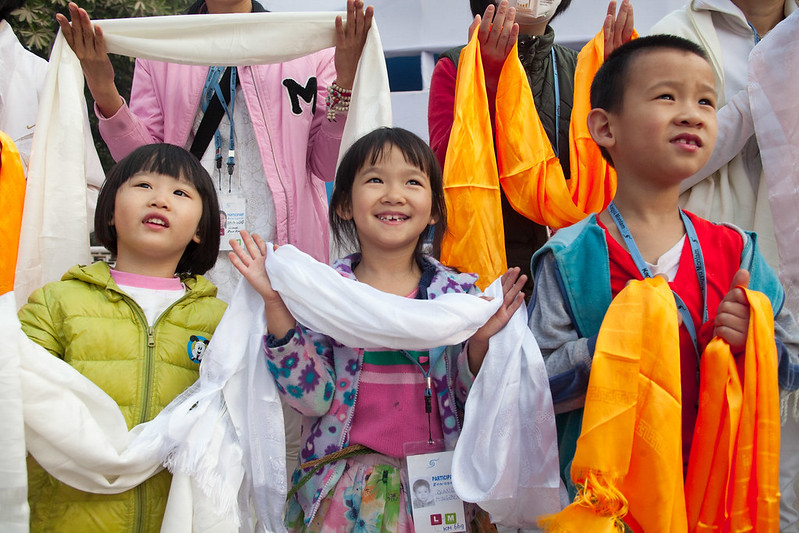
Having stayed up the whole night practicing, on February 19 in the early morning of the last day of the Monlam, the lamas wore a long white cloth wrapped around their bodies, the red Kagyu hat, a yoga belt, and short pants when they exited the main shrine hall of Tergar Monastery. With their arms on their hips and slowly turning side to side, they walked to the Monlam Pavilion between long rows of disciples with khatas to honor their efforts in practice. The lamas came down the central aisle and sat on the stage to the Karmapa’s left while the ordained monks sat on his right. As part of the Offerings to the Guru, the retreatants sang Milarepa’s song, the Essence of Dependent Arising, and received a specially blessed gift from the Karmapa. It was an auspicious beginning to the revival of another key element in the Kamtsang Kagyu lineage, famous for being a lineage of great practitioners.

20170219AM_Cotton-clad Procession&Awards given to the cotton-clad lamas

Awards Ceremony for the 20th Kagyu Gunchoe and the Examination of Monastic Forms

Awards Ceremony for the 20th Kagyu Gunchoe

Monlam Pavilion, Bodhgaya

A lively demonstration by monks from the 20th Kagyu Gunchoe of their debating skills on the topic Turning the Wheel of Dharma preceded the awards for the Gunchoe debate competition. This was followed by a long dedication monologue delivered by Lhagpa Yeshe, a monk from Benchen Shedra. This composition containing sections in both verse and prose is the traditional way to finish a debate and is known as the Noble Words [Tib.Tsig Zang].

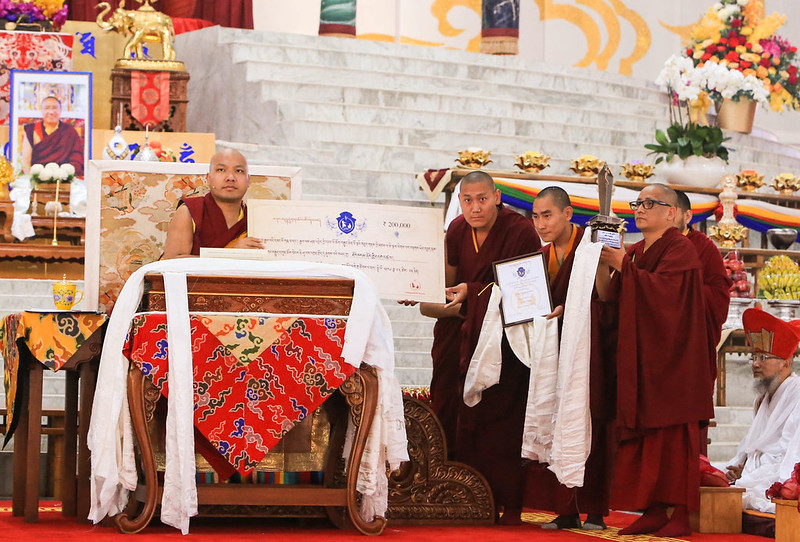
Then came the awards themselves. The winners received a trophy, a certificate and a cheque to be spent by their shedra.

First prize for Collected Topics (Dudra) was awarded to Lava Shedra. They received a trophy depicting a pecha atop a lotus and stem, and a cheque for 100,000 Indian rupees.

Second Prize for Collected Topics went to Benchen Shedra. They received a trophy of Manjushri’s Sword of Wisdom and a check for 50,000 Indian rupees.

First Prize for Validity [Tib. Tsema] was awarded to Bokar Shedra. They received a trophy and a cheque for 100,000 Indian rupees.

Second Prize for Validity went to Sherabling Shedra. They received a trophy and a cheque for 50,000 Indian rupees.

First Prize Overall was won by Bokar Shedra, which received a Manjushri Sword of Wisdom trophy and 100,000 Indian rupees.

The ceremony continued with prizes for individual monks. With great humour, His Holiness pretended not to be able to read the names of those who had won the individual prizes, and let the tension mount, but eventually he announced:

Best Presenter: Tsering Dorje, Sherabling Shedra.

Best Responder: Jamyang Sengye, Bokar Shedra

Best for Diligence: Lobsang Tsering, Sherabling Shedra

Each monk received a certificate and a personal prize of electronic equipment.

Awards for The Examination of Monastic Forms

The examination was conducted over two nights last week before the Monlam began. Twenty- four monasteries and nunneries competed against each other. The competition is organised into two categories : gelong [fully ordained] and getsul/getsulmas [novice].

At the moment there are no fully ordained nuns, so the prizes in the first category all went to monasteries. However, in the ultimate development of the trend seen last year, when nunneries won two of the three prizes, all the prizes in the novice category were won by nunneries this year. Karma Drubdey Nunnery from Thimpu in Bhutan won first prize for the second year in succession.

Category One: Gelong

  1. Thrangu Tashi Choeling
  2. Rumtek Monastery
  3. Lava Monastery

Category Two: Getsul and Getsulma

  1. Karma Drubdey Nunnery
  2. Palpung Yeshe Rabgye Ling Nunnery
  3. Thrangu Tara Abbey

20170219AM_Prizes from the Gunchoe, Prizes from Examination of Monastic Forms