




KM-banner1.jpg
KM-banner9.jpg
KM-banner10.jpg
KM-banner11.jpg
KM-banner12.jpg
KM-banner13.jpg
KM-banner14.jpg
KM-banner15.jpg
KM-banner16.jpg
KM-banner25.jpg
KM-banner24.jpg
KM-banner23.jpg
KM-banner22.jpg
KM-banner21.jpg
KM-banner20.jpg
KM-banner2.jpg
KM-banner19.jpg
KM-banner18.jpg
KM-banner17.jpg
KM-banner26.jpg
KM-banner27.jpg
KM-banner28.jpg
KM-banner29.jpg
KM-banner3.jpg
KM-banner30.jpg
KM-banner31.jpg
KM-banner4.jpg
KM-banner5.jpg
KM-banner6.jpg
KM-banner8.jpg
KM-banner7.jpg
Shadow

The Torch of True Meaning: Session Two

A Summary

The Karmapa emphasized the importance of sustaining our commitments once we have received an empowerment and nurturing through practice the seeds it has planted. He also pointed out how we really do not know what the Buddha looked like as images of him came some 600 years after his parinirvana. He is also said to be inconceivable, but that might prevent us from establishing a heartfelt connection with him, and therefore, we meditate on the lama as inseparable from the Buddha.

The General Report

The Karmapa began his talk today by explaining the difference between the guru yoga that is a part of the mahamudra preliminaries and the Four Session Guru Yoga by the Eighth Karmapa, Mikyö Dorje. There are numerous guru yogas of various lengths in the Karma Kamtsang tradition, the Karmapa explained, and among them all, the most precious is the Four Session Guru Yoga. However, people from different traditions have received the Chakrasamvara empowerment and made the commitment to do a guru yoga practice, but this does not mean that they have to do a Kamtsang guru yoga, as it is perfectly fine to do one from their own tradition.

That said we must do one guru yoga, because it is not enough to have received the empowerment. The seeds of the four kayas have been planted in our being so we need to appreciate and nurture this potential. If we just toss the seeds aside, they will simply rot away. In sum, the Karmapa stated that there are a great number of yidam deity practices and guru yoga is more encompassing as it contains them all. Whether we do a long or short one is up to us, but we must take a guru yoga into our practice.

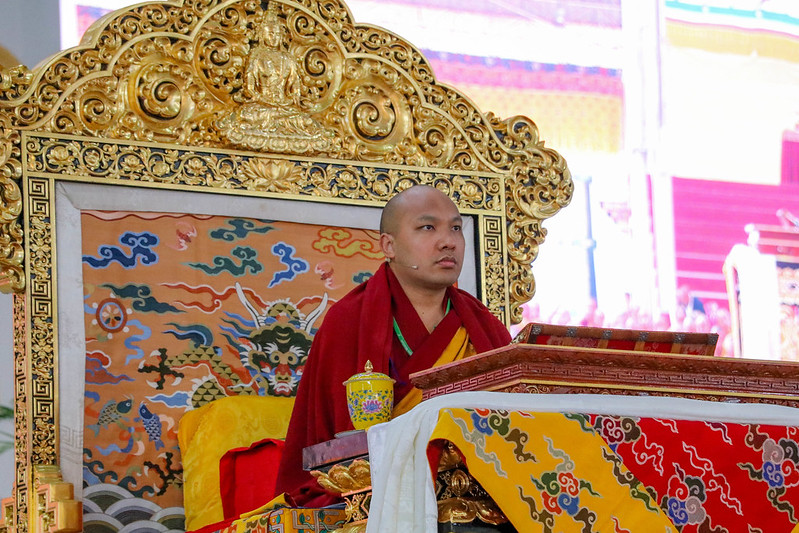
The Karmapa then turned to the guru yoga in the Torch of True Meaning, which explains the preliminary practices in the Karma Kamtsang tradition and commented on the reading transmission he gave yesterday, which covered the visualization for guru yoga. The text seems to be saying that we can visualize the guru above our heads or in front but actually the meaning is that the guru is in the sky directly in front of our head. His throne is held up by two lions in each of its four sides and covered in brocades and silks; on top of a lotus and moon seat is our teacher in the form of Vajradhara (Dorje Chang). The text describes him as “the combined essence of all the buddhas of the three times.” From the outside, his form resembles Vajradhara, however on the inside, he is our kind root lama, who has taken the form of Vajradhara. This visualization helps us to see our lama as a realized being.

The Karmapa then queried: Who is the Buddha? If we do not know, how could we possibly meditate on our guru as the buddha? When we think of the buddha, the Karmapa commented, what usually comes to mind is a golden statue of a figure resting in meditative equipoise. (The Karmapa turned around to point out the tall buddha behind him.) But if we think about it, we can see that the first statues of the Buddha were created some 600 years after his lifetime, so we cannot say for sure what the Buddha really looked like.

Even if we could have been present during his life, it would have been difficult to recognize him, so we have to use our imagination to guess how he was. A story recounts that when the Buddha was practicing austerities for six years while sitting under a tree on the banks of the Naranjuna River, he became so emaciated that he came to resemble the tree itself. When a young Brahmin woman offered him yogurt (some say it was kheer, sweet cooked rice), she thought she was giving it to a tree spirit.

When he became enlightened at dawn, the Buddha again was sitting alone under a tree as many meditators in India have done for centuries. Looking at him from the outside, there was nothing special to see. He was simply relaxing in a serene and peaceful atmosphere with no one to applaud his achievement.

Usually it is said that the Buddha is inconceivable, way beyond our ordinary minds. However, if we think of him like as some mythical being, it is difficult to make a heartfelt connection with him. To remedy this, we meditate on our authentic lama as the Buddha, thereby creating a connection so we can feel closer to the progenitor of the lineage.  

The Karmapa returned to the text and continued describing the field of refuge. We visualize our root guru as Vajradhara, and in a column above him are the lineage lamas, surrounded by siddhas of the Kagyu practice lineages, such as Drikung, Drukpa, Tsalpa, and Taklung plus gurus from other lineages, such as the Great Perfection, the Six Yogas, the Path and Result, Pacification, Chö, and Mind Training. Surrounding them are the gatherings of yidam deities, buddhas, bodhisattvas, heroes, dakinis, Dharma protectors and guardians. If it is too difficult to imagine all these figures, the Karmapa said it would be all right to consider that all of these beings are embodied in the central figure of Vajradhara. It is especially important to think of our lama as incorporating all of the Three Jewels.

Recalling a story about Drukpa Kunley, the Karmapa clarified why it is important to visualize our lama as connected to the buddhas, yidams, and so forth. If we do not, there is a danger of ignoring these other figures, and just focusing on the lama, whom we imagine to be a plump, yellow-robed monk or a wild tantric yogi. This is just mixing some concepts together and meditating on them, the Karmapa stated. Therefore, we must not reject the myriad figures in the field of refuge but see them as inseparably connected to our guru. Actually this is the case, since their essential nature is the same: There is not one yidam deity separate from our lama. This way of thinking also enhances our feeling that the guru above our head is worthy of veneration. In this frame of mind, we fervently supplicate the lama from the depths of our heart.

For the stages of the practice, the Karmapa explained that usually, the deity is generated through imagining the samayasattva and invoking the jnanasattva to dissolve inseparably into it. Here, however, this is not necessary, so we imagine that these two are inseparable from the beginning and that the field of refuge is directly present before us. Afterward we can recite the long lineage prayer, which is in the practice text, or the Short Vajradhara Lineage Prayer. In former times, people recited the prayer at the beginning of the Four Session Guru Yoga, starting, “My mothers, great in number as the extent of space.…”

Speaking in general about supplicating, the Karmapa remarked that there are wonderful prayers of calling the lama from afar, especially the one composed by Jamgön Kongtrul Lodrö Thaye. However, in these prayers, we criticize ourselves top to bottom, listing our many faults and describing how terrible we are. On the one hand, it is good to recognize our shortcomings, to see our faults as faults, but as Drukpa Kunley remarked, our supplications to the guru wind up being merely criticism and put-downs of ourselves. “Whatever direction I turn to, it’s inauspicious.  Wherever I sit, grass won’t grow.” This wailing is not supplicating the lama as the texts intend.

Instead, the Karmapa explained, along with numbers of living beings as vast as space, we pray to the lama—seen as the essence of all lamas—with as much devotion as we can summon from the depths of our being. This also provides the opportunity for us to rest in meditation on the empty aspect of our experience of devotion, thus combining the practice of devotion with mahamudra.

The text then speaks of taking the four empowerments. In the secret mantra tradition, the Karmapa taught, it is important, and not easy, to maintain our samaya commitments and do the practice every day. The self-empowerment is a way to restore downfalls by taking the four empowerments described in the text. Traditionally, it is said that a broken samaya should be restored within the duration of a session, and this is another reason why Mikyö Dorje’s guru yoga is done in four sessions, two in the morning and two later in the day. With this, the Karmapa concluded the session for the day and will continue to teach the guru yoga in two sessions tomorrow.
20170209PM_Torch of True Meaning Session2Guru Yoga

The Torch of True Meaning: Session One

This year sees the conclusion of a five-part teaching begun by the Karmapa on 31st December 2012, the year in which the Kagyu Monlam commemorated the Jamgon Kongtrul lineage, and hence the choice of this text by the First Jamgön Kongtrul Lodrö Thaye.

The text is a guide to the ngondro or preliminaries to the practice of Mahamudra in the Kagyu tradition.  First, come the common preliminary meditations—known as the four thoughts which turn the mind to Dharma, they are the precious human life; death and impermanence; karma, cause and effect; and the unsatisfactoriness of life in samsara. Then  come the special preliminary practices. At successive Monlams, His Holiness has completed giving instructions on the first three: Refuge and Prostration; Vajrasattva Practice; and Offering the Mandala. This year he will be teaching the final special preliminary practice which is Guru Yoga and giving pith instructions on Karmapa Mikyö Dorje’s  Four-Session Guru Yoga.

The Karmapa emphasised once more that those within the Karma Kamtsang who had just received the Chakrasamvara empowerment had committed to a daily recitation of then Four Session Guru Yoga for the rest of their lives. However,   those from other traditions or not within the Karma Kamtsang were free to practice the most important guru yoga from their individual tradition instead.

He warned:

The main point is that merely taking the empowerment is not enough. Taking the empowerment makes you capable or suitable for practising the path of secret mantra and so once you have taken the empowerment if you continue the practice it will be beneficial. Otherwise, if you have received the empowerment and you think that’s an end to it, there’s nothing more to be done, and just sit back and relax, that will not be good. You absolutely need to continue the practice.

For those who already had many yidam practice commitments, it was possible to transform the Guru Yoga into an all-encompassing practice by imagining that the Guru is the union of all the yidams and protectors.

Having read the first section of the text, His Holiness clarified why, when we practice guru yoga, we do not practice in our ordinary form but imagine ourselves and meditate on ourselves as a yidam deity. “We need to forcefully block ordinary impure appearances. If we block them and develop pure appearances, we will be able to easily receive the blessings,” he explained. This gives us confidence and also alters our perceptions.

However, unlike the ordinary experience of wanting to emulate a film star or pop singer whom we admire, when we visualise ourselves as a yidam deity, it is not the same as pretending to be something we are not because “all of us have within ourselves the buddha nature, the seed which can awaken to buddhahood”. The Karmapa then gave a brief summary of the two distinctive views on the nature of emptiness: shentong [empty of other] which is the basic view adopted in Mahamudra practice, and rangtong [empty of self]:

This then is the buddha nature. In the Prasangika tradition this is basically described as the object or emptiness, but in the Tathagatagarbha tradition, or the tradition of the Shentong school, which is also the Mahamudra tradition, we say that buddha nature is not merely the object emptiness, not merely a no-negation, it is not merely an absence. Instead, we say that it is the luminous wisdom, the conscious subject; it has the nature of luminosity. So in the Middle Way School, they say that this intrinsic nature of things, the dharmatā  [Tib.chö nyi] is the fact that all phenomena are empty of their own nature, but they do not actually point out what that dharmatā  is. In the Tathagatagarbha tradition, the Shentong tradition, they maintain this is what the dharmatā is, what the nature of all phenomena is—this conscious subject of wisdom.

So, when we meditate on a yidam deity such as Avalokiteshvara, it is not the same as pretending because we all share the same wisdom [Tib.yeshe] as the yidam deity.  “In terms of the aspect of natural purity or in terms of their essence there is not the slightest difference.  In terms of its form, there is the distinction whether it is obscured by the adventitious stains or not. But in terms of its nature, it is actually stainless and unobscured,” the Karmapa stated, comparing this to gold. Gold has to be extracted from ore and smelted, but there is no difference in the essential nature of the gold when it is in the ore and the gold once it has been smelted and purified.

His Holiness then considered the question on which deity we should meditate, and explained that in the Karma Kamtsang  the tradition is to visualise ourselves as Vajrayogini  (Tib.Dorjenaljorma) in the form of Vajravarahi (Tib.Dorjephagmo) for several reasons.  First, she was the yidam deity of the Kagyu forefathers, Marpa, Milarepa and Gampopa. Second, she represents the co-emergent Mahamudra. Finally, Gampopa gave Dusum Khyenpa, the first Karmapa, the practice of Vajravarahi as his creation phase practice.

“To visualise yourselves as Vajrayogini you need the empowerment of Vajrayogini. However, the Vajrayogini empowerment is restricted and cannot be given freely,” the Karmapa explained. “For that reason, I gave the Chakrasamvara empowerment….Chakrasamvara is the father aspect so I think that it is possible to then meditate on the mother aspect.”

“If you are able to visualise yourself as Vajravarahi, that’s good. If you cannot do that, visualise yourself as another yidam deity,“ he concluded.

The morning’s teaching session ended at this point. During the tea-break the assembly recited the Twenty-One Praises of Tara, and then in the second part of the morning session, everyone had the opportunity to practice reciting the Four-Session Guru Yoga, led carefully and slowly by the chant masters.

20170209_Torch of True Meaning Session1&2Guru Yoga

The Main Chakrasamvara Empowerment


On this remarkable day, after two days of initial rituals, the followers of Gyalwang Karmapa had, for the first time, been given the opportunity to receive the grand empowerment of Chakrasamvara from the head of the Kagyu lineage.

His Holiness introduced the initiates into the meaning of Secret Mantra clarifying that the word “mantra”, in Chinese translations, means “the words of truth”.

“It is when we speak in accordance with the nature of how things are, the power of those words, and the way of bringing benefit to the world through that power,” he said and illustrated the point with stories of Angulimala and Buddha Akshobhya. The Angulimala Sutra tells of Angulimala encountering a pregnant woman unable to give birth. Buddha advised that Angulimala, who had killed many people in the past, could, by the power of the truth of his resolve not to kill anymore, help that woman give birth easily. At the time he was a bodhisattva, the protector Akshobhya made the vow to never get angry at anyone, which he kept until reaching buddhahood. His name, the Immoveable, signifies the verity of his unwavering resolve.

His Holiness explained that though it is said there are millions of Mother tantras, Chakrasamvara is the quintessence of them all. Of the three Indian sources of the Chakrasamvara tantra—Luipa, Kandipa and Krisnacarya( (Skt. Kṛṣṇācārya)— it was the one from Luipa, passed down through Naropa and then Marpa the Translator, which he was bestowing.

The 17th Karmapa then imparted the Madhyamaka tradition Bodhisattva vows by following the words found in The Way of The Bodhisattva initially in Tibetan, and repeated in English and Chinese. He expounded on the symbolism of the vajra as the ultimate bodhicitta that focuses on the Svabhavikakaya essence. As the “prajñā that realizes emptiness”, it breaks the iron cage of ego clinging.

Once the empowerment had been given, the siddhis were conferred to everyone present by Yongey Mingyur Rinpoche, Drupon Dechen Rinpoche, Gyaltsen Rinpoche and Ringu Tulku Rinpoche. While this was happening, His Holiness enumerated the 8 commitments of the refuge vows given the previous day: the need to serve the guru, listen to the dharma of the Buddha, properly examine the teaching, seek liberation, be careful of your actions of body and speech, keep the vows whether they are the day-long fasting vows or the 5 lay precepts, be affectionate and compassionate to sentient beings and make offerings from time to time. He concluded with a short comment on the boddhisattva vows, the principal one being not to  give up on sentient beings.

As the assembly slowly dispersed, the Gyalwang Karmapa performed the closing ceremony of the mandala’s dissolution, yet another elegant and vivid reminder of the empty nature of all phenomena.

20170208PM_Chakrasamvra Empowerment Day3 Main practice

Preparing for the Chakrasamvara Empowerment

This second day of the empowerment began privately as the Gyalwang Karmapa performed the lama’s preliminary practice for the empowerment (dbang sgrub). During this time, the Vajra Master enters into a samadhi focused on the deity to actualize its special qualities. This middle day of the ritual is known as the preparatory empowerment (stag gon gyi dbang) as it prepares the disciples to receive the actual empowerment on the third day.

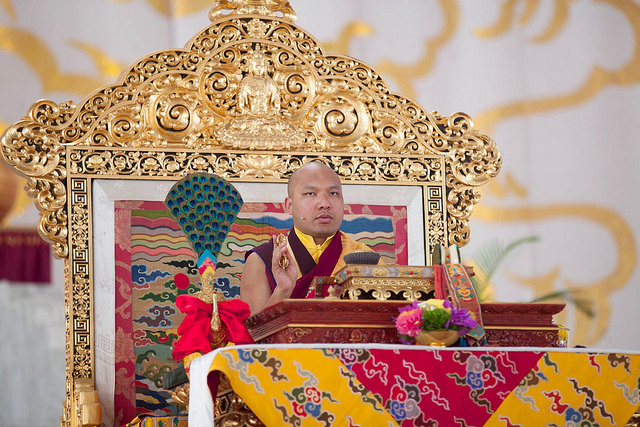
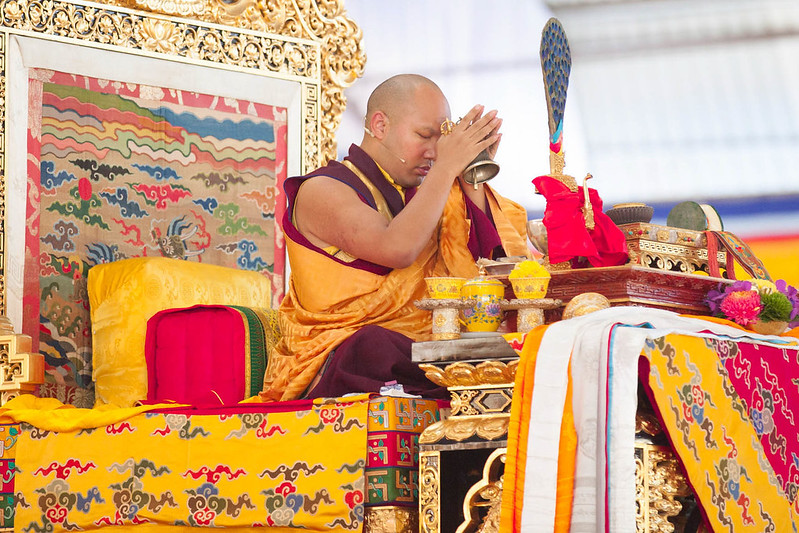
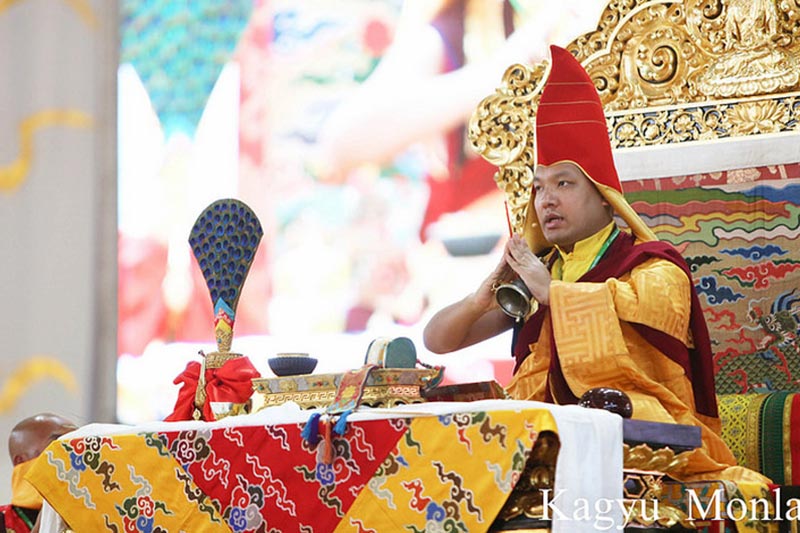
Today the stage was the same as the night before, except that in stage center, the grand black and gold peacock throne has been unveiled. At the top of the back panel is a golden image of Amitabha, on the front of its tall table is a pair of his mount, the peacock, and the stairs leading up to the throne are decorated with a swirling, powerful dragon. The Monlam Pavilion in front of the throne was filled with a sea of the ordained sangha and lay community.

His Holiness entered wearing a magnificent peach and yellow chö (outer cloth), and finishing three bows, took his seat on the peacock throne. After the preparation of setting up the vajra tent, he reminded the disciples how important bodhichitta is and that the reason for receiving this empowerment is to nurture our ability to bring all living beings to the state of perfect awakening.

After a mandala and the representations of body, speech, and mind were offered to His Holiness, he explained that he was giving the empowerment since this year he will be teaching the guru yoga from the Torch of True Meaning as well as the Four Session Guru Yoga of the Eighth Karmapa, Mikyö Dorje, and one should have an empowerment for these practices. In speaking of the benefits of this empowerment, the text states that having received a human body, we must make it meaningful. This does not mean becoming powerful physically but developing the power of our mind so that we can greatly benefit others.

In particular, human beings have prajna (wisdom) that allows them to engage in Dharma practice and differentiate what they should and should not do. Since we have the leisure and resources to practice, we should not procrastinate but engage right away since everything is impermanent and no one knows when they will die. Further, no one is independent; we are all influenced by our afflictions that lead us astray. Fearing death, the Karmapa commented, is not worrying about getting sick in Bodh Gaya, but fearing that one has not turned one’s mind fully to the Dharma—the only thing that will benefit us as we pass into another life.

The Karmapa began the actual preparatory tantra by first counseling everyone to develop the highest motivation commensurate with this highest tantra: to attain liberation and omniscience. If we seek to enter a mandala that transcends this world, our motivation should match it. Given our encrusted, thick habitual patters, we need to constantly check and improve our motivation. This setting of our motivation is the most important part of the preparation. If it goes well, then the rest of the empowerment will, too.

The Karmapa also gave the refuge vows in Tibetan for lay people and repeated them in English and Chinese so that people could understand the meaning. As the Vajra Master, the Karmapa then blessed the body, speech, and mind of the disciples, commenting, “Everyone has buddha nature in their being; they have the essential nature of a buddha’s body, speech, and mind, so this inseparability of our nature and the buddha’s nature is not something newly made but there in its purity from beginningless time.

20170207_Chakrasamvara Empowerment Day2 Preliminary Practice

The Grand Examination of Monastic Forms

This extensive test of protocol for monks and nuns was established by the 17th Karmapa as part of the on-going programme to train up monks and nuns. In 2004 he issued a code of conduct for monastics based on both the Vinaya precepts set out during the life of the Buddha himself and ritual aspects unique to the Tibetan context. He then personally trained a core group of monks and nuns to take the instructions back to their institutions. Finally, he sent a team of senior monks, headed by the Ven. Yongey Mingyur Rinpoche, to tour all Karma Kagyu monastic institutions in India, Nepal and Bhutan, in order to check the conduct of the monks and nuns and, where necessary, train them further. The six major areas covered by the code of conduct are the correct way to wear the robes; the correct way to prostrate; the correct way to walk; the correct way to sit; the correct way to accept food and drink; and the correct way to chant offering prayers.

The Karmapa himself began examining the sangha at the 25th Kagyu Monlam in 2007. In the beginning, only selected monks and nuns from participating monasteries and nunneries were called up to be tested but at the 31st Monlam in 2014 the test was extended to include everyone. Then, at the 32nd Monlam, also in 2014, the test was transformed into an annual competition and renamed the Grand Examination of Monastic Forms, with prizes awarded to the winners on the last day of the Monlam.

Although more than fifty nunneries and monasteries join the Kagyu Monlam each year, only twenty-four core Karma Kamtsang institutions take part in the annual Grand Examination of Monastic Forms. There are prizes in two categories:  gelong [fully ordained monks] and getsul and getsulma [novice monks and nuns]. In the latter category, monks and nuns compete equally against each other.

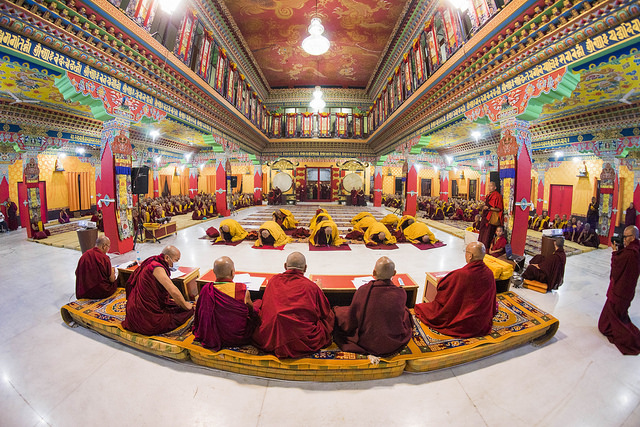
This year’s competition was held over two evening sessions in the shrine room at Tergar Monastery. A lottery established the order for the test. One by one the monasteries and nunneries presented themselves in front of a panel seven judges.

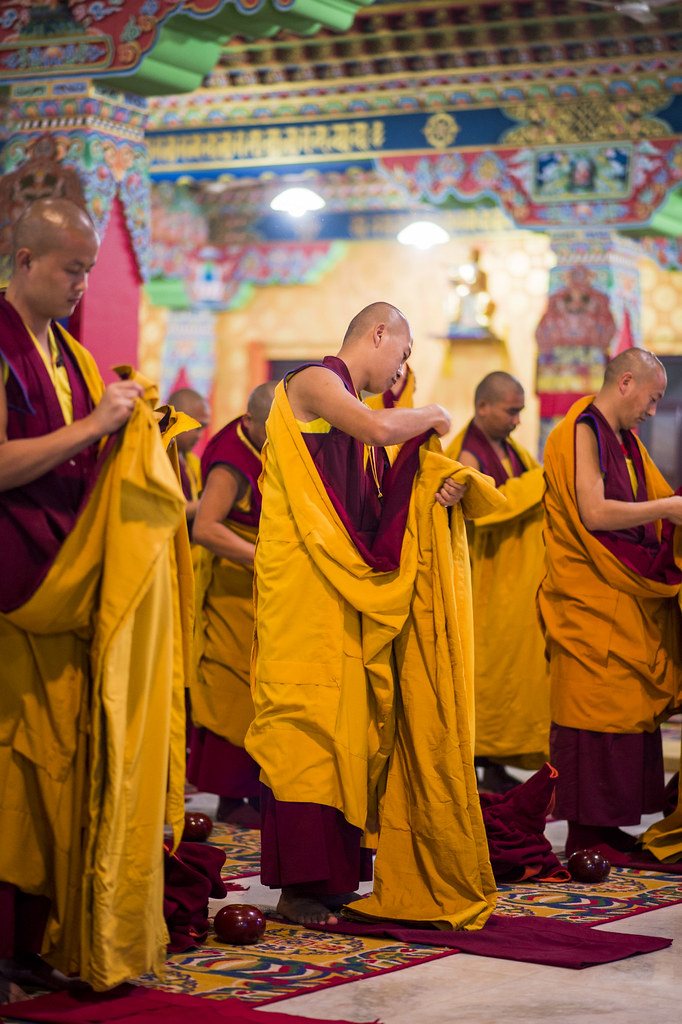
Getsul and getsulma had to show that that they knew how to wear all the robes properly, how to put on the red zen and the chögu [yellow prayer shawl], how to perform prostrations when wearing the prayer shawls, how to place the sitting cloth —the dingwa— on the floor properly, and how to receive tea and recite the tea offering prayers. Gelonghad many extra tasks. They had to demonstrate that they knew how to put on the namjar [the additional yellow monastic robe they wear], the tsesha [the large yellow hat], and the dagam [the warm winter cloak]. They then had to walk in a dignified manner while carrying dharma texts in the prescribed way, over the left shoulder and supported by both hands. These tasks were synchronised across the group to the beat of a wooden bell. The demonstration was timed, and extra points were awarded to those who completed the tasks most quickly and efficiently.

The results will be announced and the prizes awarded in front of the great assembly on the final day of the 34th Monlam Chenmo Prayers.

Grand Examination Of Monastic Forms