






KM-banner1.jpg
KM-banner9.jpg
KM-banner10.jpg
KM-banner11.jpg
KM-banner12.jpg
KM-banner13.jpg
KM-banner14.jpg
KM-banner15.jpg
KM-banner16.jpg
KM-banner25.jpg
KM-banner24.jpg
KM-banner23.jpg
KM-banner22.jpg
KM-banner21.jpg
KM-banner20.jpg
KM-banner2.jpg
KM-banner19.jpg
KM-banner18.jpg
KM-banner17.jpg
KM-banner26.jpg
KM-banner27.jpg
KM-banner28.jpg
KM-banner29.jpg
KM-banner3.jpg
KM-banner30.jpg
KM-banner31.jpg
KM-banner4.jpg
KM-banner5.jpg
KM-banner6.jpg
KM-banner8.jpg
KM-banner7.jpg
Shadow

Aspiration of Mahāmudrā: Meditation Day 3: The Path


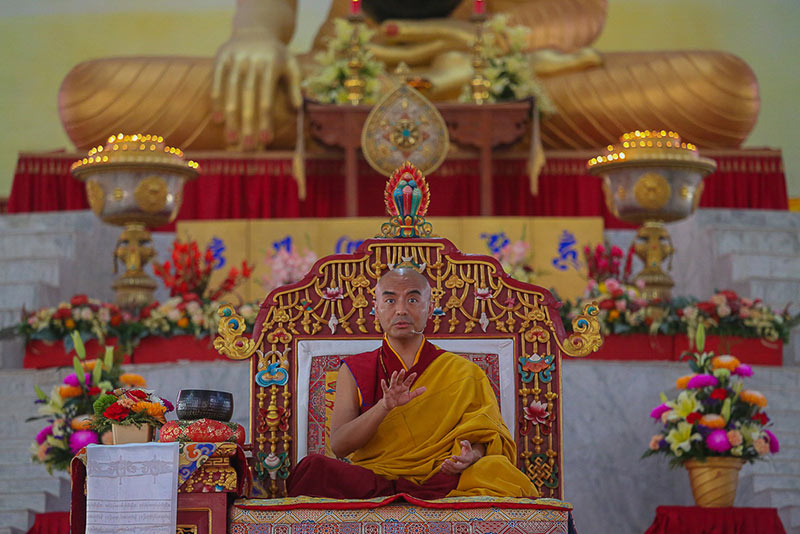
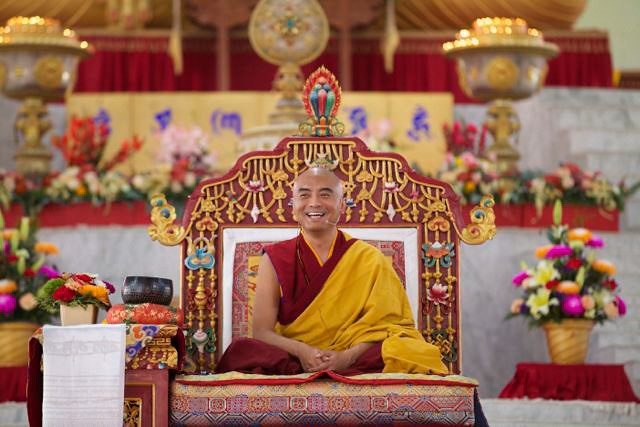
Mingyur Rinpoche’s final session of meditation instructions brought together the meditation experiences of the previous two days and, at the request of the 17th Karmapa, focused especially on mahāmudrā.

Rinpoche began by reminding everyone that the motivation of all Buddhist practice should be bodhichitta— to be able to bring ultimate benefit to sentient beings as limitless as space. They all possess the buddha nature but fail to recognize this because of ignorance, which is the result of karma. They wander in the three realms and six classes of saṃsāra and though suffering is but a dream, they create suffering, he said. We meditate and listen to the dharma in order to bring them to the state of buddhahood. Using this as the basis for the first meditation of the session, Mingyur Rinpoche instructed everyone to adopt the seven-point meditation posture and reflect on bodhichitta.

Next, Rinpoche led everyone in a śamatha meditation with the breath and body as a support. Close the eyes and focus on the breath, he instructed. After a minute or so, he began a meditation on the foundation of body and feelings. Beginning at the crown of the head note the sensations. Move the attention to the nape of the neck, to the back and so forth. Repeat this until you have scanned the whole body. Now direct your attention to any general sensation you feel across your body such as heat or tiredness, sleepiness, discomfort, unhappiness or pain. “If you are viewing them,” he reminded us, “you will not be controlled by them. If you are looking at the river, you will not be carried away by it.”

Mingyur Rinpoche then summarized the main points of mahāmudrā that he and Gyaltsap Rinpoche had covered. In general, he explained, there are three types: sutra, tantra and essence mahāmudrā.

Mahāmudrā means primarily a stamp or royal seal. This means that there are no phenomena that go beyond the expanse of mahāmudrā: the nature of mahāmudrā contains all phenomena of saṃsāra and nirvāṇa. Sutra mahāmudrā is primarily taught in texts such as the King of Samadhi Sutra. These are the words of the Buddha. In the commentaries, it is taught primarily in the Uttaratantra [Maitreya’s Sublime Continuum]. Tantra mahāmudrā is practised primarily in the Six Yogas of Naropa and uses tantric methods working with the winds, channels and drops. It focuses on the creation and completion stages, examining the emptiness of great bliss and the meaning of the co-emergent wisdom. Essence mahāmudrā is primarily when the guru points out the nature of mind with pith instructions and you recognize it, based primarily on devotion to the guru and bodhichitta.

The aim of all mahāmudrā is recognition of the buddha nature which is found in all sentient beings, Mingyur Rinpoche explained. It is present within all of us: everything we think and do occurs within the expanse of the buddha nature. It doesn’t become worse in saṃsāra or better in nirvāṇa because it is the basis of both If we recognize our own nature, we will gradually achieve buddhahood.

The Aspiration of Mahāmudrā reads: By not realizing this, we wander in saṃsāra.
‘This’, Rinpoche commented, refers to the ordinary mind which is aware, experiences and thinks. The essence of this ordinary mind is the buddha nature. If we recognise this, we become buddhas otherwise we wander endlessly in saṃsāra.

In mahāmudrā we employ three stages of meditation in order to recognise this: shamatha meditation, insight meditation, and the union of shamatha and insight. In mahāmudrā shamatha is called ‘searching for the view through meditation’. First, we use shamatha to establish meditative concentration, and then we recognize the essence and establish the view. In mahāmudrā insight meditation, we receive pith instructions on searching for the mind from the guru, then we investigate thoroughly, thus we come to the view, and, finally learn to rest in the view without distraction. We can also go between the two using them in union.

Mingyur Rinpoche elaborated that because there were practice requirements for pointing out instructions, so he was not allowed to give those to a general audience. However, the meditations he had used over the previous two days were the first stage of shamatha meditation and suitable for everyone. They were imbued with the flavour of mahāmudrā and followed Jetsun Milarepa’s three points: don’t wander; don’t meditate; don’t fabricate.

There are three important meditation instructions, Rinpoche continued: stillness, motion and awareness. Stillness is mind resting in its own nature; motion is the mind thinking about different things; awareness means just knowing. If we are still and we know it, if our mind is in motion and we know it, we are in meditation. But just as important as meditation, we need to develop the qualities of compassion, devotion to the guru, and dedication. These combined will eventually lead us to recognise the nature of the mind.

Mingyur Rinpoche then led two meditations, the first on stillness, followed by one on the mind in motion.

Meditation on stillness (shamatha without the attributes):
a. Let the mind relax as it is, like when you take a deep breath. Even if you know how to meditate, you shouldn’t. Breathe in slowly, hold your breath, let it out through the mouth forcefully, and then relax. That feeling of relaxation is awareness. You are aware of being relaxed.
b. The instruction is “Don’t wander; don’t meditate”
Just rest the mind, without it being distracted. You are aware.
After scanning the body, just rest in open awareness, in equipoise, letting thoughts come and go.

Meditation on the mind in motion (how to meditate one-pointedly on thoughts):
Don’t block thoughts, let them become the support for the meditation. Yesterday the breath was the support for the mind to be undistracted. Similarly we watch the thoughts as they come and go. We think about many different things. When we meditate on thoughts we need to watch the thoughts, like the thumb counting beads on a mala. Our awareness is watching the thoughts.
In place of the breath, in place of sound, watch your thoughts without being distracted.
Now let your mind be.

Meditation on thoughts usually has two outcomes, Rinpoche observed:

1. The thoughts disappear when you watch them; usually when we meditate there are too many thoughts but when we try to watch them they disappear. Why? Because the mind has come into stillness. No longer distracted for an instant or two. Rest in that instant. The watcher is awareness.
2. You can watch the thoughts one after the other, like watching TV. The thoughts come here, go there.Only a few people are able to do this, because most people get distracted by their thoughts.When you are watching your thoughts you are not being controlled by them.
When you can see the river, you are not in it.

Whichever outcome, he reassured people, was excellent.

The greatest obstacle to the quality of meditation, he warned, is distraction. Torpor, dullness, agitation can all be used as a support to meditation, but if we forget to watch that’s insurmountable. Non-distraction is the essence of meditation. People sometimes focus mistakenly on bliss or non-thought, but these are experiences not the essence of meditation. As the Short Vajradhara Lineage Prayer instructs:

The main practice is being undistracted, as is taught.
As ones who, whatever arises, rest simply,
Not altering, in just that fresh essence of thought…

Whatever thoughts arise, we should not try to alter them or stop them, he advised. Even if the thoughts are inappropriate, rude, and superstitious and so on, we should not try to alter them; the practice is to rest in the essence uncontrived without distraction.

Non-distraction is awareness. Whether we are resting in stillness in shamatha or resting in motion, both are resting in awareness. Since we were born, we have had a string of thoughts but they weren’t meditation, he added wryly. Only when awareness is present does it become meditation.

Mingyur Rinpoche then provided some pointers for the stages ahead in mahāmudrā meditation. This practice of stillness, motion and awareness within mahāmudrā is part of shamatha, he explained. If we begin with bodhichitta and devotion to the guru, if we supplicate the guru, and then engage in this practice of stillness, motion and awareness in mahāmudrā, the awareness will dissolve into the stillness and the motion. At that point the three will become two.

As we continue to meditate, those two —the awareness-in-stillness and the awareness-in-motion—become one, like waves subsiding into the water. Everything becomes a display of awareness. At this point there is no object of meditation and no meditator; nothing apprehended no apprehender; no doing, nothing done; no subject, and no object. Everything coalesces into one.

Some people are concerned at this point that something is amiss with their meditation. In fact, this is recognising the nature of the mind, and the stage known as ‘arriving at the level of lesser simplicity’.
If you persevere and continue to put effort into practice, you will definitely achieve realisation, he assured everyone.

Mingyur Rinpoche then spoke of the Three Stages of Awareness. Usually our awareness is mixed up with the afflictive emotions.

A. Through mahāmudrā practice we recognize awareness and that becomes the main aspect of our meditation. There are various methods and supports we can use for our meditation to strengthen our awareness. The object is irrelevant. This awareness, however, still has an aspect of subject/object, an elaborate conceptual aspect, it’s like ‘the sky and the earth’.
B. The second stage of awareness is called the ‘herdsman’s awareness’— the tending awareness.
C. At the point where we have recognized the nature of the mind, the mind becomes self-aware; aware of its own nature – the union of clarity and emptiness. We can experience this through the state of meditation. It cannot be taught in public. There are pith instructions through which we can experience the mind free of elaboration: it becomes clear, brilliant, vivid and direct. Yet at the same time there is nothing to be found. This is buddha nature. It is there the whole time but we do not see it. It is hidden in plain sight.
Mingyur Rinpoche concluded the third session with a short guru yoga meditation and instructions on how to make dedications. Resting in the nature of emptiness is the best way, he commented, but, alternatively, you can imagine that all the buddhas and bodhisattvas are in front of you as you make the dedications for the benefit of all sentient beings.
The meditation session had begun with generating bodhichitta and the resolve to bring all sentient beings to the state of buddhahood. Now it concluded with the dedication of any merit gained that all sentient beings might attain buddhahood and that the Gyalwang Karmapa might have a long life.
Although Mingyur Rinpoche had been unable to give direct pith instructions to a general audience, he had used those three afternoons through skillful means to bring the essence of meditation into everyone’s experience. And, as people drifted away to their own rooms, they spoke of how extraordinary the sessions had been and how blessed.
20180224PM_Aspiration of Mahamudra Review&Meditation3-3

Aspiration of Mahāmudrā: Meditation Day 2: Cultivating Awareness

Mingyur Rinpoche’s second session emphasized what it is to be aware and how to cultivate being aware. He began with a request, “Please raise the attitude of bodhichitta to listen to these teachings. As I mentioned yesterday, if we want to practice the essence of the 84,000 dharma teachings, we begin with going for refuge and arousing bodhichitta.”

To arouse bodhichitta, we need to develop loving-kindness and compassion. This is accomplished in several ways such as recognizing our parents and being grateful to them and exchanging ourselves with others. Leading us into a meditation on loving-kindness and compassion, he said, “First identify someone you easily feel loving-kindness and compassion towards.” Mingyur Rinpoche gave a personal example. When he was younger, he meditated on his grandmother who was short and always had a smile. “The key,” he continued, “is to think that individual is just like me and wants to be without suffering; then, in this way we mediate on loving-kindness and compassion.” As the meditation continued, he expanded this, “Now think of someone else and then all sentient beings throughout space. May they all have happiness and the causes of happiness. May they be free from suffering and the causes of suffering. If you can think like this, this is loving-kindness.”

He shifted the focus to increasing the strength of our awareness, noting that a single object such as the breath or sound can act as a support. “When we recognize that we have the motivation to meditate, it doesn’t matter what the mind is resting on,” he clarified, and then moved on to awareness.

Awareness is like the sky. Clouds might gather in the sky as well as wind and lightening and hail, but it does not affect the sky at all. The sky might be clear blue and have rainbows, but that doesn’t make the sky any better. It all occurs within the expanse of the sky. Likewise, awareness is just knowing and if a good thought happens, that’s fine. If a good feeling happens, that’s fine. If an unpleasant feeling happens, that’s fine; and, if a neutral feeling happens that’s fine. If you feel tight, that’s fine. If you feel loose, that’s fine. It is all like clouds in the sky. Even if those clouds stay in the sky for a long time, it does not affect the sky.

In order to cultivate awareness, you rest within whatever thoughts, afflictions, or appearances arise and they become part of your meditation. When you are able to rest within – whether gentle experiences of bliss or clarity or rough experiences of pain or dullness – it becomes an aid for awareness.

Building upon Goshir Gyaltsap Rinpoche’s teachings, Mingyur Rinpoche turned to a verse from The Aspiration of the Māhamudrā of Definitive Meaning which teaches all the points of shamatha.

Not sullied by the meditation that is conceptual effort,
Not stirred by the wind of ordinary distractions,
May we know how to rest naturally and freely, not altering.
May we be skilled in and sustain the practice of the mind. (p.356 Kagyu Monlam Book)

This verse emphasizes the whole way of resting within – “don’t meditate, don’t wander, don’t fabricate.” Rinpoche explained, “We might think to ourselves, why is this saying ‘don’t meditate’? But when we do shamatha, we do not need to do anything. In shamatha and māhamudrā, we rest with whatever occurs in our mind without altering it.” The key is not to let the mind wander which means developing non-distraction. This is just looking and being aware. He gave a clear analogy: “A shepherd brings his flock up into the hills, he sits down and lets the sheep go wherever they go. He watches whatever they do.”

Lastly, we do not need to fabricate or change anything. We have so many afflictions, but because we are not aware, we fall under their control. Mingyur Rinpoche said, “It’s like a rushing, raging river, if you fall into it, the water will carry you away. When you can see the river, you are not in it. Likewise, with our thoughts and afflictions, if we view them and do not fall under their control, they do not harm us.” Whatever afflictions – greed, hatred, delusion – arise in our mind, we aim to look and see them without falling under their control. The main point is that we are able to direct our attention and cultivate this awareness.

Mingyur Rinpoche next introduced a technique focused on pain. He smilingly asked, “Do you have any unpleasant feelings?” Hands went up throughout the pavilion. For those few who did not have any unpleasant feelings, he instructed to squeeze the soft flesh on the hand between the thumb and forefinger. “Direct your attention towards any feeling of pain in your body and if you don’t feel anything, squeeze your finger on that spot and direct your attention towards it.” He concluded the meditation explaining that unpleasant feelings can also be aids to meditation.

The last guided practice entailed paying attention to whatever appears in the mind. “Please close your eyes,” he said. “Now, as you close them, whatever feeling happens for you, direct your attention towards it.” Whether a feeling of dullness, a foggy torpor or vivid clearness, just rest in it. “Just look at the sensation,” he encouraged.

“We need to recognize awareness and develop confidence in the awareness of our meditation,” he concluded.

20180223PM_Aspiration of Mahamudra Review&Meditation3-2

Aspiration of Mahāmudrā: Teaching Day 2: The Ground of Samsara and Nirvana


Today, Rinpoche began his commentary on the section in Karmapa Rangjung Dorje’s text specifically aimed at mahāmudrā practitioners, detailing the aspirations for the realisation of mahāmudrā. These verses cover the actual practice for the practitioner: establishing the unmistaken view of the fundamental nature, general conduct of meditation, and how to practice mahāmudrā meditation.

As the latter section of these verses is practice oriented, Gyaltsap Rinpoche emphasised repeatedly the necessity for students of mahāmudrā to receive individually tailored instructions from a qualified teacher.

The aim of a mahāmudrā practitioner must be to establish the correct view, and the first few verses in the section (p.355 Kagyu Monlam Book) concern eliminating exaggerations about mahāmudrā, the nature of the mind: both the misconception of a permanent self and the misconception that the mahāmudrā is either a thing or is void and empty. Rinpoche elaborated:

We sentient beings cling to things as either existent or non-existent. We need to eliminate this clinging. It is a confusion. For this reason, Nagarjuna and other scholars negated both existence and non-existence. If we can eliminate both of those, we will be able to understand the nature of both the ultimate and the relative…and we will have the certainty of the view. The certainty of the view brings joy in knowing …Sustaining that view without distraction is the point of meditation.


In meditation we should not be distracted by our thoughts, nor should we block our thoughts, thinking of nothing at all, which leads to complete unknowing, worse than ignorance. “Whatever arises – thoughts, appearances, sounds, forms –we rest in the confidence of mahāmudrā. That is the point of meditation,” he explained.
We train in the conduct of mahāmudrā to aid and increase the power of our meditation. The tantras teach many different types of conduct such as reciting mantras, using a damaru and bell, wearing robes, but they themselves are not important except as a way to strengthen our meditation by increasing our meditative concentration.

The text now presents an explanation of the mind as the ground of samsara and nirvana. The section begins:

All dharmas are the mind’s manifestations.
The mind: there is no mind; it is empty of mind’s essence.
Empty, it is unceasing, and can appear as anything.

Because we fail to realise this, we are confused, and, as Rangjung Dorje states, we mistake self-appearance as an object and self-awareness as a self. From this mistaken view we develop self-clinging, which is the root of samsara. From self-clinging arise attachment and aversion, and the many afflictions of pride, envy, wrong views and so forth. Because of these afflictions we accumulate karma; consequently we experience samsara and the three types of suffering. For that reason whether you hold the Mahayana or the Mind-Only view, the basis of samsara is the mind, and that is why, when we meditate on mahāmudrā, we first examine the nature of the mind. Where is it? What is it like? Is it a composite or non-composite? Does it have a beginning and an end? When we meditate and cannot find anything, this is a sign of successful meditation.

Some people suggest that the mind does not exist, that it is void. This can be refuted because when we are not aware of the mind’s true nature, we accumulate karma and wander in samsara through the twelve branches of dependent arising. On the other hand, the peace of nirvana also arises from the nature of the mind. Listeners and pratyekabuddhas are able to achieve nirvana because they partially realise the nature of the mind. But only when the nature of the mind is fully manifest do we achieve the four kayas of the Buddha. Rinpoche commented further:

The mind is neither something nor is it nothing. These are not contradictory: the nature of the mind is not an existent eternal self, this is non-existent, but it is also the nature of all phenomena so it is not anything either. It is these two in union. It is the middle way that does not dwell in any extreme.


As the text says: May we realise the mind’s nature, beyond extremes.

How then can we realise the ultimate nature? The Buddha gave it many names —emptiness, the ultimate nature, co-emergence— as a skilful means to help people understand. We should first of all contemplate these names and thereby we are able to reveal the ultimate nature, but then there is nothing to illustrate or indicate it, because, ultimately, the nature of the mind is beyond concepts and cannot be described. Through names and words we can arrive at the ultimate nature which is beyond names and words.
However, as sentient beings our minds arise from the cause of ignorance and cannot realise the ultimate nature. Only by eliminating ignorance can we realise the ultimate nature by using the antidote of the aware primordial wisdom.

As the text says:

Not realising this we circle in samsara
If this is realised, buddha is not elsewhere.
Everything is this, there is nothing that is not this;
May we know dharmata, exposing the all-basis.

This teaches how emptiness and relative interdependence are unified. “The difference between buddhas and sentient beings is whether they are aware or not,” Rinpoche stated. A sentient being is unaware, a Buddha is aware. “All the afflictions, the five poisons all the intentions for committing malice in samsara are, by nature, mahāmudrā.” When we enter the path, and meditate on the true nature, that which we meditate upon and that which meditates upon it are both mahāmudrā.

All the teachings of the great masters, all the miracles, going forth as a nun or monk, all are the nature of mahāmudrā. Other than the dharma expanse, there are no phenomena at all. In this instance, the all-basis, the ālaya, means the nature of mind. The text goes on to say that “all appearances are mind”; emptiness is also a manifestation of mind. All confusion and delusion are also in essence mahāmudrā. There are many methods to eliminate these misconceptions, Gyaltsap Rinpoche advised. Then we should begin mahāmudrā meditation.

The next section of the teaching introduced the methods of mahāmudrā meditation.

First came a consideration of the environment which is suitable: at the beginning we need to be away from the distractions of mundane life such as temporary physical pleasures and earning money. We need to go to an isolated place where our meditation will not be harmed and where there is nothing to be attached to. Having adopted the seven-point meditation posture of Vairochana, we should rest in the unaltered nature of mind, uncontrived and undistracted.

Mahāmudrā meditation has to be done continuously and then we will definitely see results, Rinpoche counselled. It uses both śamatha and vipaśyanā (calm abiding and insight), and our teacher should advise us which is best for us, according to our meditative experience.
In the Kagyu mahāmudrā tradition, the aim is not to stop our thoughts but to use them as a support: the more thoughts the better the meditation, they are fuel for the fire. People wrongly think that thought-free samadhi means we have to block all thoughts. But the Kagyu masters explain this as all thoughts become the nature; the thoughts are calmed and ‘the river of mind, unmoving come[s] to natural rest’.

Gyaltsap Rinpoche then gave more detailed meditation instructions for practitioners on the path of mahāmudrā. He spoke of the difficulties which may arise and their antidotes, different forms of meditation, and pointing out instructions accompanied by short meditations.

After the tea break, for example, he gave a vivid example to illustrate the meaning of appearances are mind. Thousands of people were gathered in the Monlam Pavillion but each had an individual mind and a separate eye consciousness, therefore an individual perception. So, within the pavillion there were thousands of perceptions of just one pillar. After a short time to meditate on this, he gave a further example. When we see forms with our eyes, each person has their own perception. Another example is that of child, adult and elderly person. When a child looks at a mountain, they see somewhere to play; an adult sees somewhere to work; an elderly person sees difficulties.

But when we look at the mind we cannot find it. When we look at external objects we cannot find them either. As the text says: Looking at both, dualism is liberated in its own place. Thus dualistic clinging to something apprehended and an apprehender dissolves. This is what the Buddha called the luminous nature of mind, Rinpoche commented. So the nature of the mind is to be able to see and know everything yet we cannot find it.

The text now introduces the practice of śamatha and vipaśyanā in unison.

Freedom from mental engagement is mahāmudrā, it states. Our thoughts are usually dualistic, Rinpoche explained, so they are mental engagement or mental fabrication. But mahāmudrā is present from the beginning and does not need to be fabricated. The word ‘mudrā’ means a stamp or seal, and ‘mahā’ means great. It is not beyond the extremes of existing and not existing, of being or not being, nor is it dwelling in the centre. It is also called the great perfection because all phenomena are contained within it. It contains all the Dharma and all four classes of tantra, hence: To know one is to realise the meaning of all. The realisation of mahamudra will depend on our capacity. Most of us are not able to eliminate all the obscurations immediately and so are unable to have this extensive knowledge of all phenomena.

As our practice of mahamudra progresses, it is crucial to be without attachment to any meditation experiences, and to be able to distinguish between experience and realisation. Especially, we should not be fixated when we experience the clear light of luminosity. If, instead, we become fixated on our experiences they will become an obstacle to our meditation.

We may be distracted from our practice by worldly concerns and activities. If we neglect our practice in any way, we need to confess through recitation of the 100 syllable mantra or the Confession to the 35 Buddhas. The meditation on the green dakini from The Four Session Guru Yoga can also be used.

Yet, as Gyaltsap Rinpoche assured everyone, “If we practice with diligence there will definitely be experiences and realisation.”

Rinpoche’s second day teaching was very profound and it is impossible to cover all the important points he made. This article only provides a part of what was said. The complete teaching is available on YouTube https://www.youtube.com/watch?v=6azo354pM4Y&t=46s

20180223AM_Aspiration of Mahamudra Teaching3-2

Aspiration of Mahāmudrā: Meditation Day 1: Being Aware

In the first session of his pre-Monlam teachings, Mingyur Rinpoche distilled the essence of meditation, practicing non-distracted awareness. He began the afternoon by summarizing the profound teachings on mahāmudrā detailed in Goshir Gyaltsap Rinpoche’s commentary on the Aspiration of Māhamudrā of Definitive Meaning. Mingyur Rinpoche said these pith instructions are a distillation of the Buddha’s 84,000 teachings. To make it even easier for us, Mingyur Rinpoche joked, he had kindly condensed these 84,000 teachings into three key points: preparation, main practice, and follow through.
Preparation is refuge and bodhichitta. When we go for refuge, we are making a sincere promise to go to the Buddha as a teacher, the Dharma as the path, and the Sangha as companions on the path. “Who is the Buddha?” Rinpoche asked. “An ordinary sentient being with afflictions due to ignorance.” If we are able to rid ourselves of the adventitious stains we accumulate while wandering in samsara, then, because we all have Buddha nature, there is absolutely no difference between us and Shakyamuni Buddha and Vajradhara, he explained.
The Buddha has inconceivable qualities like omniscient wisdom. Not only that, he also has loving-kindness and great compassion. Without these latter two qualities, he would be like the armless mother in a great flood who could not rescue her children. This raises the question: If the Buddha has qualities of omniscient wisdom, loving-kindness, and great compassion, why do we experience so much suffering? The answer is simple: each person experiences suffering due to the ripening of their karma. A second question is: If the Buddha cannot do anything to rid us of our negative karma, what is the benefit of going for refuge? The answer is that by going for refuge we can purify and exhaust our karma according to the power of our aspirations and supplications, whether they are small, medium, or great.

Out of the blue, Mingyur Rinpoche scanned his audience and asked, “Are you hot? If so, raise your hand.” A sea of hands shot up. “If you know you are hot, that is awareness,” he smiled. To further emphasize the nature of awareness, we were led in a series of exercises. First we had to raise our hands and hold them in the air until we felt the heaviness, and slowly lowered them. “If you recognize the feeling that you have in your hand, that is awareness of feeling,” he commented. “There are three types of feeling – pleasant, unpleasant, and neutral. When you put your hand down, it is a pleasurable feeling. So, if you recognize feelings of pleasure, it is also awareness. When you are walking, recognize walking; sitting, recognize sitting; eating, recognize eating…and if you know what you are doing that awareness becomes meditation.”
In a mischievous manner, he smiled and said, “I have a small quiz to give you, but it isn’t difficult so you shouldn’t worry. Whatever I say, respond immediately. If you understand mindfulness, raise your hand.” Numerous hands shot up and he said, “Okay, good.” Then the quiz continued, “If you did not understand mindfulness, raise your hand.” Again, hands filled the pavilion and he encouragingly said, “That’s also good.” Lastly, “If you have some doubts about whether or not you understand mindfulness, raise your hand.” And just a few people raised their hands. He then clarified that each answer demonstrated signs of awareness.
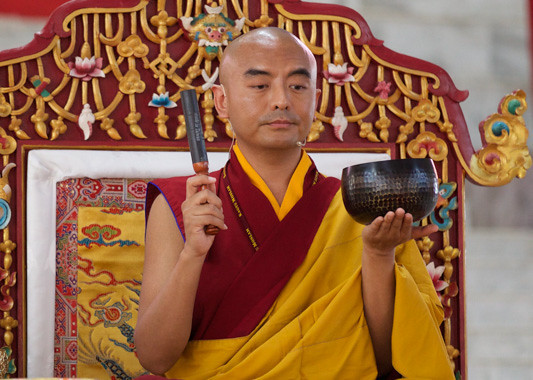
Next, came a meditation on sound. He struck the edge of the meditation bowl once.
“If you heard the sound,” he said, “that is the awareness itself.” He then continued ringing the meditation bowl and as the reverberations slowly ceased, he struck it again. “The main point here is knowing you are listening and directing your mind to whatever sound you hear and knowing that you hear it, whether it is the sound of the bowl’s reverberations, a motorcycle, or so forth.” Thoughts may arise. Even while listening, you may think, ‘momos’ but that is perfectly fine, just keep listening to the sound. However, if you find you are listening to the sound and suddenly lying in your bed or sitting in a restaurant and you do not know how you got there – that’s distraction! If you are listening to the sound and not forgetting it, even while thinking about momos[Tibetan dumplings] or daal baati [rice with lentils], then you are not distracted. But, he reiterated, the essence of meditation is awareness which is knowing and being aware no matter what happens in your mind. This is the essence of non-distraction – the main practice of meditation.
Following the sound meditation, participants were guided in shamatha practice on the breath. Mingyur Rinpoche instructed everyone to count how many breaths within a minute: “Breathe in, breathe out, one; breathe in, breathe out, two; breathe in, breathe out, three and so forth.” “There is always a point where you do not need to count anymore,” he observed,
“ and we can slowly work up to that.” Whether the sound or shamatha meditation was easier is dependent on our constitution, he explained, and we should practice which comes more readily.
The last guided practice was voiceless, mantra meditation; the silent recitation of a mantra such as “Karmapa Khyenno.” This is the most sacred within the name mantras, Rinpoche made clear, and when we recite it there is no visualization, solely an invocation of the Karmapa, who is the embodiment of the activities of all the Buddhas.
The session came to a close with two instructions – firstly, to practice five to ten minutes of meditation, preceded by refuge and bodhichitta and concluding with dedication; secondly, between formal meditations, to take up post-meditation practice by being aware, wherever you go, that you are walking and so forth.
This concluded the first day of the pre-Monlam teachings.

20180222PM_Aspiration of Mahamudra Review&Meditation 3-1

20180222PM_Aspiration of Mahamudra Review&Meditation 3-1

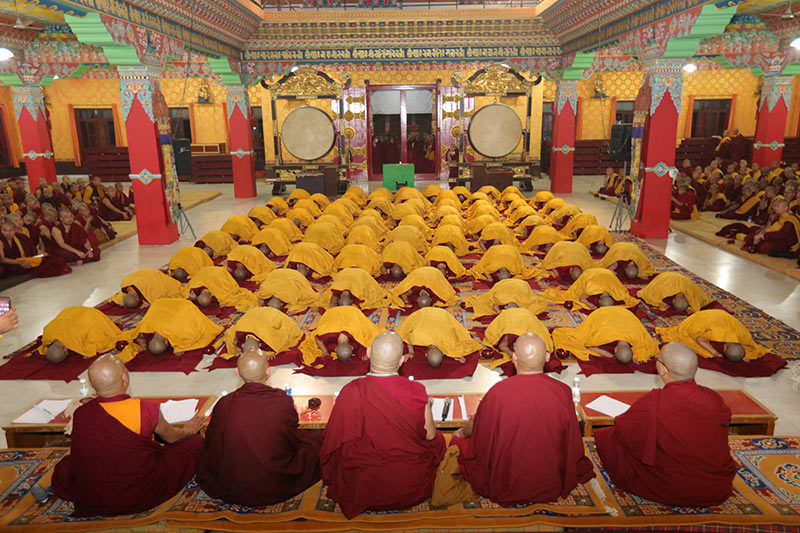
Testing the Nuns and Monks: The Grand Examination of Monastic Forms

Each year, before the Monlam begins, the monks and nuns are put through their paces in front of a panel of judges. In 2014, at the 32nd Kagyu Monlam, the examination became an annual competition, with prizes awarded in two categories:  gelong [fully ordained monks] and getsul and getsulma [novice monks and nuns]. In the latter category monks and nuns compete against each other equally.<br>
Although more than fifty Kagyu nunneries and monasteries are represented at the Kagyu Monlam each year, only a core of twenty-four enter the competition. This year’s competition was held over two evening sessions in the shrine room at Tergar Monastery. A lottery established the order for the test, which had to be completed under timed conditions, the countdown displayed on a screen. The panel of judges comprised six senior khenpos, headed by Khenpo Lobsang Nyima, principal of Karma Shri Nalanda Institute for Higher Buddhist Studies, the shedra at Rumtek Monastery.

The monks and nuns had to demonstrate that they knew the correct way to wear the robes; the correct way to prostrate; the correct way to walk; the correct way to sit; the correct way to accept food and drink; and the correct way to chant offering prayers.

So far, although outnumbered by the monks, the nuns have been particularly successfully in the competition. As there are no fully ordained nuns yet in the Kagyu tradition, they can only compete in the novice category, but last year they took all three prizes! Karma Drubdey Nunnery took first prize, Palpung Yeshe Rabgye Ling Nunnery was second, and Thrangu Tara Abbey came third.

Usually the prizes are awarded on the last day of the Monlam but this year, as His Holiness the Karmapa is unable to attend the Monlam, the winners will have to wait until the 36th Monlam, when the 17th Karmapa himself will present them in a special ceremony.

20180222Examination of Monastic Forms

20180222Examination of Monastic Forms