











KM-banner1.jpg
KM-banner9.jpg
KM-banner10.jpg
KM-banner11.jpg
KM-banner12.jpg
KM-banner13.jpg
KM-banner14.jpg
KM-banner15.jpg
KM-banner16.jpg
KM-banner25.jpg
KM-banner24.jpg
KM-banner23.jpg
KM-banner22.jpg
KM-banner21.jpg
KM-banner20.jpg
KM-banner2.jpg
KM-banner19.jpg
KM-banner18.jpg
KM-banner17.jpg
KM-banner26.jpg
KM-banner27.jpg
KM-banner28.jpg
KM-banner29.jpg
KM-banner3.jpg
KM-banner30.jpg
KM-banner31.jpg
KM-banner4.jpg
KM-banner5.jpg
KM-banner6.jpg
KM-banner8.jpg
KM-banner7.jpg
Shadow

The Soliloquy of Geshe Potowa: Session Four

Monlam Pavilion, Bodhgaya

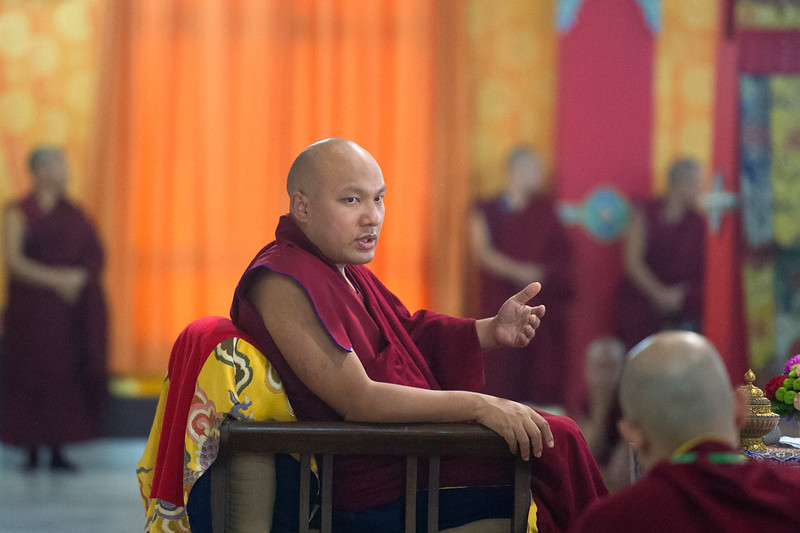
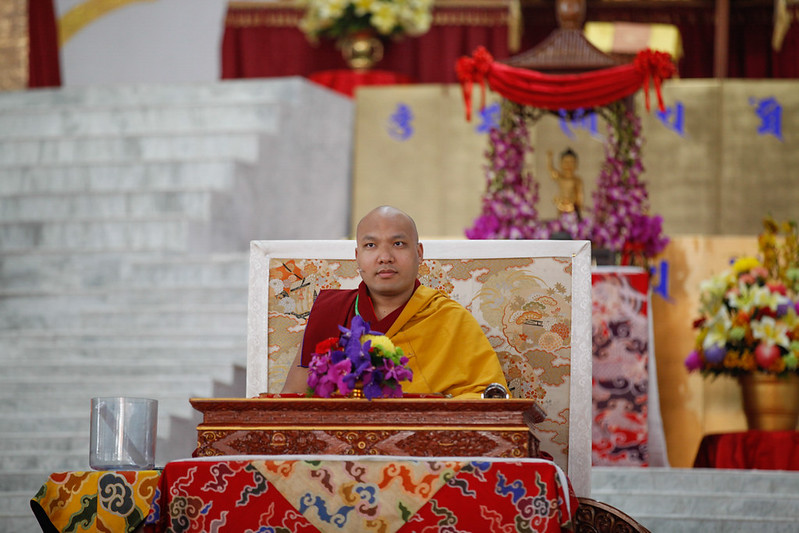
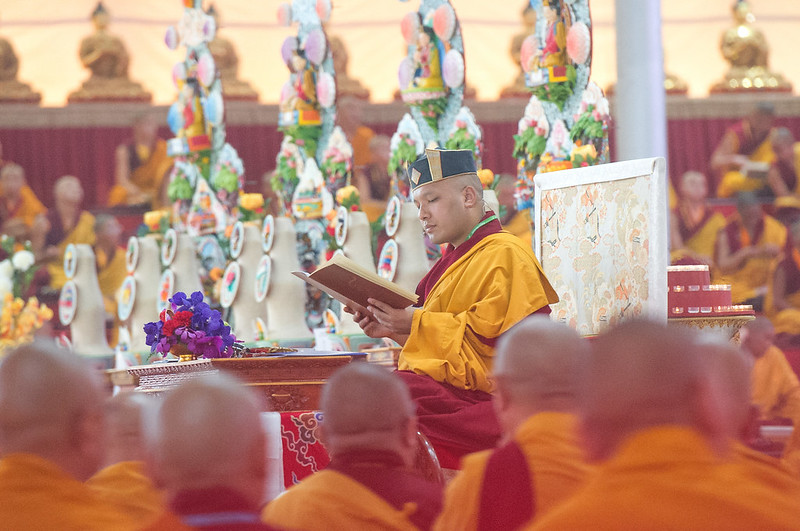
Today, His Holiness reflected on the part of Geshe Potowa’s Long Soliloquy, which had virtue in monasteries as its focal point. He encouraged everyone to nurture enthusiasm and bodhicitta, the essence of which is the union of emptiness and compassion, to guide our efforts to benefit others. Following a short instruction, he concluded with a meditation session. Though he had completed this year’s Monlam teaching, he had not exhausted the content of the whole text and announced that the teaching on the text would extend for one or two more Monlams.

The Karmapa read Geshe Potowa’s accounts of visiting monasteries. When he inquired after fine individuals, he was often told that these fine individuals, the life-blood of the monastery, were the wealthy ones, with much gold, turquoise and cattle. Equating wealth with virtue meant they were immersed solely in the matters of this life. “You should leave that place” Geshe Potowa urges “just as a bird leaves a lake when it freezes.”

The text continues with a teaching on not expecting repayment for helping others:

Anyone who wants to practice should not even give food to their fellow practitioners with the strings of this life attached. If others give it to you, do not eat it. In the end, it will become a back and forth of food that will eventually cause you to lose the dharma.

The Karmapa explained that we should not expect even gratitude. Helping is done best in such a way that people are not aware we are helping them for, if they know, they might feel indebted. Likewise, we might be anticipating some positive reaction from them. Both these responses have a potential to become a basis for conflict.

Then His holiness talked about gathering wealth for old age. Though it is understandable to worry about old age, it also indicates not having certainty in dharma. We should take dharma as insurance. When faith in dharma is established, there will be no fear of old age.

The text further focuses on the ordained sangha: “Some say they lack the provisions for dharma practice and don’t practice, but they find the provisions for committing misdeeds and automatically do them. This is because rich monks don’t contemplate death and the suffering of samsara” and continues his critique “I say they are giving up the small household and taking up a larger one. What they do is dharma but their ego-clinging is even tighter than the householders.”

Clarifying these lines, His Holiness said that the act of going forth or leaving the householder’s life means to be emancipated from samsara. It means seeking freedom.

The text explains that the limitations for the ordained are much more subtle than those of a householder. By practising false dharma, their ego clinging and pride intensify to a point where they end up being worse than an ordinary householder.

But the Karmapa enheartened his audience: “To practice the dharma, we need to have a certain zeal, enthusiasm, power — strength of mind. We need to have a real belief in what we are doing. Our enthusiasm and fortitude should be stronger than anyone else’s.” He illustrated with the ever powerful example of Milarepa’s perseverance.

“Their dharma and their practice are in complete opposition,” His Holiness continued. “They say wealth and possessions have no meaning but they themselves are taking wealth as their own yidam deity.”

The Karmapa gave an interesting example depicting the modern-day advertising techniques used by some lamas abroad. “If you are worried about the university exams,” some slogans say, “then come and take this Manjushri empowerment.” Or: “If you are in financial difficulties, take this empowerment of Dzambala and you’ll be wealthy and prosperous!”

In contrast, sympathising with the troubles of lamas abroad, he recalled the story of a tulku who travelled to America for the first time. An empowerment was organised in a cinema but no one came. For the sake of auspiciousness, at least one person should receive an empowerment, so someone suggested they call the guard up. They told him how beneficial receiving the empowerment would be and he agreed to receive it. In a later conversation with him, they discovered that he was a Muslim.

In that context, His Holiness recalled the profound words of great Drukpa Kagyu Mahasiddha Lorepa: “If you gather crowds of thousands or tens of thousands of people, the benefit to others does not increase. If you only have one person in the crowd then it does not get any smaller.” He elucidated saying that when we meditate upon bodhicitta, which is in essence emptiness and compassion, it is fine to benefit only one being. However, if we don’t have it, even if we have crowds of thousands, we will not fruitfully benefit anyone.

For the end of the session, he imparted meditation instructions: “Don’t follow the tracks of the past, don’t anticipate the future. Think about the current situation. Catch that with mindfulness and relax.” Then he expounded on the essence of meditating on the breath. Taking it for granted, we neglect the fact that if we stop breathing we die. Plants produce oxygen and give us the riches which allow us to breathe. Remembering this should give us a feeling of contentment.

Since the sound from the singing bowl has a fluctuating quality, he compared meditation on the sound to impermanence. Being aware of it, does not mean we should fear death but see the opportunity to change things due to their impermanent nature. We have a chance to change our thinking. It is impermanence which allows a flute to give rise to beautiful music. Permanence, on the other hand, would mean only one note.

His Holiness personally led everyone in meditation by drawing out soothing but powerful meditative sounds from the rim of the singing bowl. As the waves of sound filled the space, he took the meditators into an open state of being. Perhaps this was to show that to meditate on the breath is to attune with the self-resounding sound of the universe.
20170216AM_Teaching Geshe potowa Soliloquy4/4

17th Karmapa Visits the Milarepa Exhibition and Friends of Kagyu Monlam Members’ Lunch at the Mahayana Hotel


Mahayana Hotel, Bodhgaya — 15 February, 2017

On the third day of the 34th Kagyu Mönlam, His Holiness the Karmapa joined the Mönlam Members' lunch, which is set out every day at the Mahayana Hotel for the duration of the event. Long before the arrival of the Karmapa, the Members had already been queuing patiently in a long line that stretched from the lobby all the way across the forecourt of the hotel to the street outside, waiting for their turn in the dining room. The Members were, of course, thrown into a flurry of excitement, hurriedly reaching for katas, as the news of the Karmapa's impending visit spread. As the wait went on, they spontaneously broke into chanting Karmapa Khyenno. And not long after, they were indeed heard, as the queue moved aside and the Karmapa's car rolled in.

His Holiness went directly to the dining room where a table had been prepared for him, and the early-bird Members were waiting with more chants of Karmapa Khyenno. His Holiness briefly went up to check the buffet, then resumed his seat as a laden tray made its way to him. As the Karmapa took out his chopsticks and mindfully sampled the meal, Members were torn between their need to get their own food - especially those trying to keep to the strictures of their Sojong vows - and their admiration of the Karmapa sitting in their midst. For many, hunger won out, and as piled plates went past and new entrants gained the dining room, excited giggles broke out as they realised whose presence they had walked in to. The Karmapa didn't stay long, though, and quickly moved on to visit the Milarepa exhibition, also being held at the Mahayana Hotel until the end of the Mönlam.

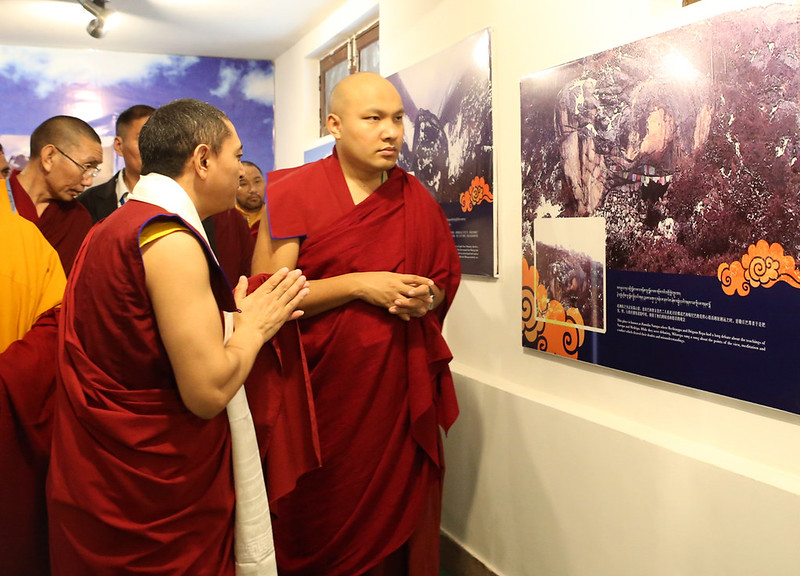
The exhibition centered on photographs of the most significant places in Tibet and Nepal connected with episodes in the lives of Milarepa and his disciples. Most of the photographs were taken directly by Lama Dawa, the organiser of the exhibition, over a period of three years. For some of the photographs of Nepal, he relied on the help of a local monastery, as the uncertain situation in the country prevented access to the sites by outsiders. Among the most spectacular were surely the Fortress of the Central Channel, on the site where Milarepa practised on a diet of nettles; the Lotus Cave on the western side of Mount Kailash; and Lapshi Snow Mountain, prophesied by Marpa as a sacred site for Milarepa.

As Tibetans crammed along the corridor waiting for a view of the Karmapa, Lama Dawa escorted him along giving a commentary on the exhibition. Having reached the end of the main gallery of photographs, His Holiness returned to where a table was set with tea and biscuits, and had a chance to look at some exhibits in more detail. He also took in the central room of the exhibition, where photographs were complemented with thangkas, statues, precious manuscripts and relics of Marpa and Milarepa. On his way out, the Karmapa took the time to greet and talk to the waiting Tibetans. Then the sirens were on, the car rolled away, and only the queue of the Members still waiting for lunch remained.

20170215PM_Milarepa Exhibition

17th Gyalwang Karmapa’s Words of Thanks to Friends of Kagyu Monlam Members

Tergar Monastery Shrine Room

Members of the Friends of the Kagyu Monlam started congregating on the lawn of Tergar Monastery early in the afternoon of the third day, in eager anticipation of their group audience with His Holiness the Karmapa. Very soon after, they were ushered into the shrine room and lined up in rows to await his arrival. With between 1,200 and 1,400 Members to fit in, that took some time and skill to arrange - testament to the effort and patience of the guru sevakas who had that responsibility, and who kept the atmosphere light with their good humour both in English and in Chinese.

There was hardly a buzz of nervous chatter amongst the waiting Members, their whispered exchanges softer even than the twittering of the Tergar shrine room's resident birds. Some took out their malas, some closed their eyes in meditation, all preparing as best they could for this longed-for moment. As had happened earlier in the day amongst the Mönlam Members waiting at lunchtime in the Mahayana Hotel, spontaneous chanting of Karmapa Khyenno rapidly spread through the rows and was sustained until, with none of the usual security to-ing and fro-ing, His Holiness walked in.

The Karmapa started by extending his warm greetings to the Members, commenting that in the years since the inception of the Kagyu Mönlam the number of participants had increased manifold. He shared his memories of the early days:

When I joined the Mönlam and started giving teachings, it was in a basement hall in the Mahayana Hotel, dark and windowless. It seemed a big venue at the time, as the Mönlam was only for foreigners. But that basement soon became too small, and we moved to the shrine room of Shechen Monastery. It was still only attended by students from abroad, but as more of them came they spilled out onto the veranda, they were opening windows and letting the mosquitos in. The Mönlam was extended to India-based participants with teachings in the Taiwan Temple, then Tergar was built.

The Karmapa observed how tight a fit the Members were in the Tergar shrine room, demonstrating the obvious need for the bigger Pavilion, and how even that was barely enough for the 10,000 people and more now taking part. He stressed, though, that drawing in a bigger and bigger crowd was not the most significant aspect of the Mönlam:

What is really important is the intended purpose which brings us together. This year, people from 50 different countries are here, united in aspiration and intent. That is what makes this gathering significant and important. We have this united purpose for peace in the world and for the well-being of all, without exception, so this is a sacred and precious gathering.

The Karmapa added that this kind of auspicious event had a tradition in the noble wishes and aspirations of previous Karmapas. He mentioned, especially, the 7th Karmapa, Chödrak Gyamtso, pointing out that prayers that were made during his time are done in the last day of the Kagyu Mönlam, and quoting an inspiring exhortation of his: "May we gather different languages and nationalities in joyous celebration. Let this happen again and again."

Continuing, the Karmapa said that when we gather together and make prayers for the benefit of all beings, we focus our attention and our attitude towards the flourishing of the profound teachings of the Buddha, and towards universal peace and harmony. He then related a recent personal experience that had made him appreciate how precious truly heartfelt aspirations can be:

A number of fellow Tibetans came to see me. Most were elderly, and told me that they had held their hopes within their minds for so long, and they now wanted to express them. They were wishing for these things, for peace and happiness for all the world, for the spread of the Dharma, and asking me to pray for them to come about, with tears in their eyes. It was more than mere words. Sometimes when things are memorised we don't experience them in depth, but this was from the core of their hearts, it was feeling articulated in words. This is not common, it is rare, so all the more precious. When people can make this kind of wholehearted aspiration, I think there is still hope for the world and for sentient beings.

The Karmapa then reminded everyone that as far as they were concerned, as Members, they couldn't be any closer to the Mönlam than they were already. That meant that they must have dreams in their life that were not limited to themselves, but were universal and global in their outlook, encompassing all sentient beings; this was a noble aspiration that they must embrace.

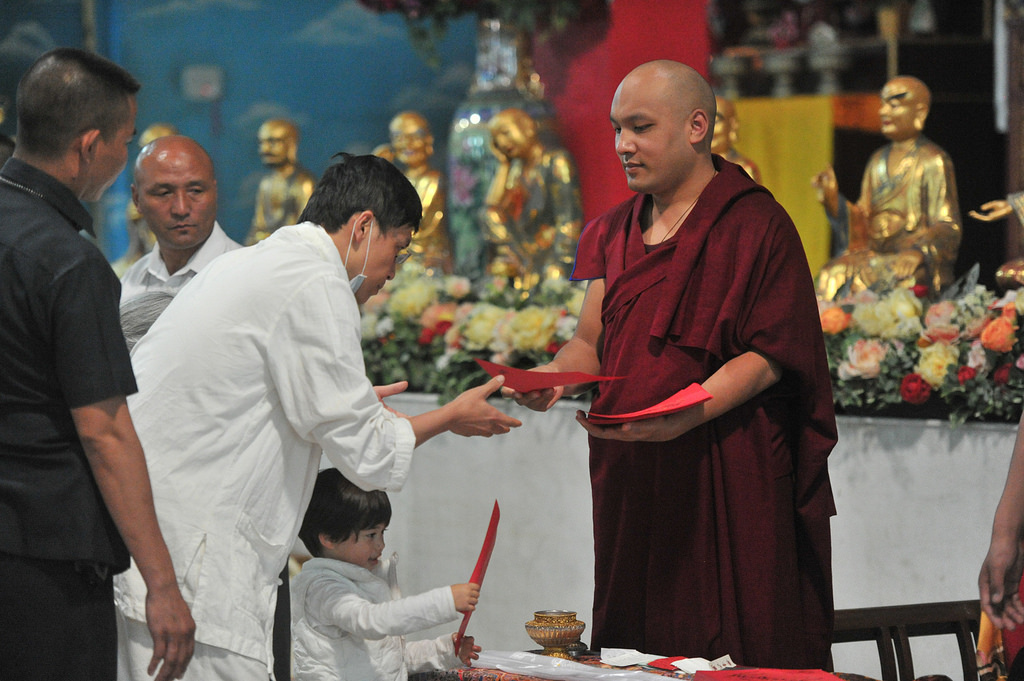
The Karmapa concluded the meeting by expressing his appreciation for the many ways in which Members supported the Kagyu Mönlam, and as a token of that appreciation, by handing out personally to each Member a calligraphy made by himself with the Tibetan words Nam Yang De - 'completely happy'.

20170215PM_Audience with Kagyu Monlam Members

The Soliloquy of Geshe Potowa: Session Three

After welcoming everyone, the Gyalwang Karmapa continued reading from the text of Geshe Potowa:

In my opinion, we must flee the suffering of samsara—the very thing we are seeking to eliminate—and gather incalculable accumulations to achieve the result, perfect buddhahood. We should practice whatever is said to have the greatest merit. When selling something like woolen cloth, if we give the buyer an extra four or five pounds without them knowing it, this will bring great merit.

The Karmapa commented that we need to put as much distance as possible between ourselves and the world of samsara so that we can end our suffering. Until now, we have experienced misery even though we wanted to avoid it. Who is fooling us? The culprit is our own mind and its attachment the pleasures and tasks of this life. It is our fixation on this lifetime that is to blame. An analogy for the situation is a fishing line with a sharp, metal barb at the end, and we are the fish hooked by these pleasurable objects we find in this life. This attachment will only pull us into another rebirth in samsara with all of its suffering.

As an aside, the Karmapa remarked that some people say they have given up on this life, but if we examine well, we can see that it is not true. Someone might take robes to gain respect, but they do not develop the qualities that would earn it, so they give up being a monk, grow their hair long, and wear a yogi’s clothes, advertising themselves as someone living the simple life. Such people are found everywhere and their search for respect is a sign that they have not yet turned away from this life.

After indicating what needs to be given up, the Karmapa turned to what should be taken up: a vast accumulation of merit, necessary to achieve full awakening. It should happen quickly so that we can begin as soon as possible to help others. How we might do this Potowa illustrates with the example of someone selling woolen cloth. If we gave the buyer an extra four or five pounds without letting them know, that would gather great merit.  

The Karmapa then read the next section of the text:

When I say this, others reply that this is taking a loss without receiving anything in return. It would be better to give it away, they say. Actually, Dharma practitioners should not want anything in return and take delight when others, who are like their parents, win instead of themselves. If practitioners are not like this, it will be impossible for them to awaken to buddhahood. Further, [this attitude of seeking something in return] is the opposite of meditating on the Four Immeasurables.

The Karmapa commented that if we were secretly generous, others would think we were a complete idiot. Such behavior is pointless, they say, since we lose and get nothing in return.  At least if we let them know of our generosity, they would be grateful. Potowa replies that if you think only of this lifetime, then it is as you say. But if you are a true practitioner, you have no expectation of a reward for your activities. You seek nothing in return.

For example, if parents have a beloved son, they would wish for him to come out on top. It would be more important for things to go well for their son than for themselves. It is similar for those who seek enlightenment: They prefer that others gain merit rather than themselves. It is this attitude that we need to develop and not just for those close to us but for all the infinite numbers of living beings, whether friend or enemy. Without this motivation, it is impossible to attain buddhahood. We might repeat the first two Immeasurables—May all beings have happiness and its causes. May they all be free of suffering and its causes—but we are just mouthing the words; what we think and what we say are in sync.

The Karmapa continued with the text:

To achieve buddhahood, we should be capable of giving away even our body and life if it would benefit others, not to mention our possessions. If a “practitioner” loses nights of sleep over a small business loss, not only are they unable to help others, they are also harming themselves.

For example, when one morning, someone offers tea to the monks in a remote valley, others might say that this person has gained merit, and the individual as well will think they have done something virtuous. But then this person stays in a well-populated valley or monastery, buying when goods are plentiful and selling when they are scarce. They neither sell at the going rates nor use the accepted measures, such as quarts and ounces. Until they achieve their wishes, they keep on pushing, not giving up until their own hopes are fulfilled and others are left powerless and miserable. This is not just one or two people, but many beings in the ten directions; it is not just for one day, month, or year but for their whole lives. In brief, they feel good if they do something virtuous for one morning but do not feel a moment’s discomfort for spending their entire lives accumulating misdeeds. I wonder what kind of a mind they have. What assurance could they know?

The Karmapa commented that if we wish to help others, we should be ready to give not only our possessions and wealth but also our very life if there is good reason to do so. This trader, however, is distressed by losing half of the load from their pack animal. How could such a person achieve buddhahood? They are like a hollow dummy that has been stuffed. On the outside they look like something but on the inside there is nothing of value. That sort of person, the Karmapa observed, could be called a lama, khenpo, master, and so forth, but these titles are just an outer show with nothing behind. Temporarily they might get some profit from this ruse, but in the end, they will know a great loss.

In a village where people have gathered, one person offers breakfast to the monks living in one valley. Others will look at this and think that this sponsor has gathered considerable merit, and the individual will also think they have done a good thing and even boast of what they have done, promising to continue in the future. Then they go to a place where goods are plentiful, securing them at a cheap price only to sell them later at a huge profit when things are scarce. They do not follow the accepted local prices, but insist on their inflated figures, and use all kinds of clever reasons to get what they want, making people miserable. Then they say to themselves, “I’m not doing this for myself but for the benefit of the lamas and the monasteries.” It is not just one person who does this but many, and they do it not just for one day, but a whole lifetime. This is not a good way to live.

Similarly some people do some practice and prayers in the morning and feel good about it but then they engage in misdeeds for the rest of the day or the rest of their lives without feeling any remorse. One has to wonder what is in their hearts. What sort of mind do these people have? What sort of assurance about the future can they have?
 
The Karmapa returned to reading the text:

Considering how they have come under the control of ego-clinging and desire, there’s no need to speak of them being liberated by seeing that their misdeeds have no inherent existence. In the first place, they haven’t even heard that in the next life, misdeeds ripen as rebirth in the three lower realms. Even if they have heard, they do not think about it. Instead, without shrinking from ill repute in this life and suffering in the next, they are able to sacrifice everything—their body, life, and Dharma—if it seems they might gain some wealth. They deserve our compassion for this is the epitome of being drowning in the causes of suffering.

The Karmapa commented that at the time of Geshe Potowa (1027-1105) and the time of Mikyö Dorje (1507-1554), there were many titles for Dharma practitioners: Chöje (Lord of Dharma), Drupthop (Realized Master or Siddha), Jetsun (Lord), Kunkhyen (Omniscient) and Gyalwang (the Lord of Victors). The Karmapa made a distinction between two other titles: a reincarnation (kukye or yangsi) and an emanation (tulku) of body, speech, and/or mind. There are also titles for scholars, such as Pandita (a scholar) or Rabjampa (person of profound learning), or they are named by what they have learned by heart—a scholar who has memorized 300,000 stanzas or even a scholar who has memorized 3 million stanzas. There were many names to be given.

Nevertheless, no matter what title people might use, if we look at how much ego-clinging they have and how much they take things to be real, there is no chance they will be liberated by seeing that things do not truly exist and that misdeeds are empty. In the first place, they have not even heard that misdeeds ripen as rebirth in the three lower realms. Or if they had heard it, they do not think about it.

On this cautionary note, the Karmapa ended his talk for the morning. It was followed by meditation on the sound of a bowl gong. The Karmapa asked people to meditate continuously on the sound as it grew larger, and then as it diminished, to see now the mind become increasingly subtle.

Afterward, the Karmapa explained that when he recites the dedications for the living and those passed away (from the collected works of the First Karmapa), he is acting as the representative of everyone, so we should all hold in mind the same prayer, wishing that all beings, as great in number as space is vast, and in particular all those connected to the Kagyu Monlam, have happiness and joy; that the living experience auspiciousness and those passed away find a good rebirth.  

20170215AM_Teaching Geshe potowa Soliloquy3/4

The Soliloquy of Geshe Potowa: Session Two

The second session of the teaching began with the text:

Thus there are few who have turned their minds away from this life. Many say they are bodhisattvas, but I wonder whether they are really focused on this life. I think about what I would do if I were to die tonight and have never considered any ambitions for tomorrow and thereafter. Because of that, I have understood the critical points of Dharma. That alone is the greatest sustenance for meditation. I had thought it would be likewise for others too, but when I tell them, their attitudes have never been compatible with mine.

His Holiness commented that this illustrates how Potowa applied the Dharma that he knew as an antidote to the afflictions. Knowing the Dharma and teaching the dharma are not sufficient. The Dharma has to be practised as it is taught, internalised and applied to our lives.

In the text, Geshe Potowa explains that people express concern for him. They label his views as too extreme and try to dissuade him from his practice. This, he argues, is one of the four black dharmas [downfalls of the Bodhisattva Vows], making someone regret doing something which they should not regret. He feels discouraged and depressed that concerned people give such advice because it is obvious to him that they have not understood the Dharma. It is as if they are saying: “Do whatever you can to not be liberated from samsara”. The problem, as he sees it, is that too many Dharma practitioners are still concerned about mundane things and have not really renounced samsara.

His Holiness commented that there are very few who turn their minds away from this life, very few who feel revulsion for this life, but there are many who claim to be bodhisattvas in order to become well-known in this life. “According to Potowa, we should not care at all whether other people consider us to be bodhisattvas or not…If we have no attachment to this life, whether we are bodhisattvas or not, whatever happens in this life our minds will remain undisturbed,” he observed.  

Potowa makes no plans for the future and mistakenly presumes that others practise similarly.  Because of this, others worry about what will happen to him and fear he will die in desperate circumstances. He, in turn, feels pity and compassion for them because they are so focused on this life and have failed to understand the Dharma.

The Karmapa continued his commentary:

We need to turn inwards and find inner conviction, belief and confidence, otherwise knowing how to meditate is of no benefit, and knowing how  to teach dharma does not help…we have to realise and truly believe that all composite phenomena are impermanent. In addition, we need to recognise and resolve that this life is futile.

Other people try to make Potowa regret the way he practices. He, on the other hand, sees how people waste their lives focused on getting food and clothing. His Holiness commented further that the sutras teach that by rejoicing in another’s virtue we gain half ourselves. Hence, if they had known the Dharma, the people should have been rejoicing in Potowa’s dedication to the Dharma.  Instead, their advice to Potowa and their actions show how attached they are to this life. Potowa found it impossible to discuss Dharma with such people and just let them prattle on.

Potowa describes how even people who were considered to be good Dharma practitioners had the wrong priorities; they said they intended to stay in a monastery to practise the Dharma intensely but first put all their efforts into accumulating food and clothing so that they would not be dependent on anyone. “There are no more than just one or two practitioners who think, ‘Let this life turn out as it will,’” he states.

His Holiness illustrated the dilemma:

If we were to live for fifty years, we would spend twenty-five of those asleep. Of the twenty-five years remaining, until you’re twenty years old, you don’t have the maturity to practise like that. So once we have reached maturity, that leaves just five years to practise. We spend a quarter of that time acquiring food and clothing. So, of that remaining five years we have only three quarters left to either practise the Dharma or do worldly things. And during the remaining time, if we think that first we are going to accomplish all we need for this life and then we will accomplish everything we need for the next life, there will not be enough time.

Having made it very clear: “It’s not possible to accomplish everything for both this life and the next,” he concluded.  

The Karmapa then compared those who have not turned away from the concerns of this life, who worry about old age and death, to bees collecting nectar. The bees spend all their time gathering pollen from flowers only to have their honey stolen in the end. There is nothing stable or lasting in this life because everything is impermanent, everything is in a state of flux, and in the end we die.

“If we cling to permanence and have strong attachment this will only increase our suffering,” he advised.

To conclude the teaching, His Holiness led a ten-minute Shamatha meditation on the sound of a special singing bowl, made from diamond dust, the residue when diamonds are cut.

“Today, I will pretend to be an artist,” he joked.

The pavilion fell completely silent as monks, nuns and laypeople sat straight-backed and focused while the Karmapa skillfully varied the speed, intensity and pitch of the resonating bowl.

20170214AM_Teaching Geshe potowa Soliloquy2/4